Mostrando entradas con la etiqueta Modern American Literature. Mostrar todas las entradas

jueves, 14 de octubre de 2021

Hemingway, Ernest Miller

(from The Oxford Companion to American Literature, by Hart and Leininger)


HEMINGWAY, ERNEST [MILLER] (1899-1961), born in Illinois, while attending school made frequent hunting and fishing expeditions in Northern Michigan, which helped condition his later primitivistic attitude. After working as a Kansas City reporter, he joined a volunteer ambulance unit in France, then transferred to the Italian infantry until the close of World War I, after which he reported battles in the Near East for the Toronto Star, and settled in Paris as a member of the expatriate group.

Influenced by Ezra Pound and particularly by Gertrude Stein, wholse style strongly affected him, he published Three Stories & Ten Poems (Paris, 1923) and *In Our Time (U.S. 1925). These early stories already exhibited the attitude of mind and technique for which he later became famous. As the leading spokesman for the "lost generation" he expressed the feelings of a war-wounded people disillusioned by the loss of faith and hope, and so thoroughly defeated by the collapse of former values that, their atrophied nerves not permitting them to attack their betrayers, they could turn only to a stoic acceptance of primal emotions. The stories are mainly concerned with "tough" people, either intelligent men and women who have dropped into an exhausted cynicism, or such primitives as frontiersmen, Indians, and professional athletes, whose essential courage and honesty are implicitly contrasted with the brutality of civilized society. Emotion is held at arm's length; only the bare happenings are recorded, and emphasis is obtained by understatement and spare dialogue.

After Hemingway returned to New York and wrote the lesser satirical novel The Torrents of Spring (1926), he carried the style and attitude of his short stories into the novel *The Sun Also Rises (1926), which tells of the moral collapse of a group of expatriated Americans and Englishmen, broken by the war, who turn toward escape through all possible violent diversions. Success in fictional craftsmanship and in portraying the mind of an era was again achieved in *A Farewell to Arms (1929), the poignant love story of an English nurse and an American ambulance lieutenant during the war. Besides further distinguished collections of short stories, *Men Without Women (1927) and *Winner Take Nothing (1933), he wrote only two lesser books during the next few years, although his work continued to exercise a great influence on the literature of the period. *Death in the Afternoon (1932), a book on bullfighting, and Green Hills of Africa (1935), an account of big-game hunting with digressions on literary matters, show a further cultivation of the primitive and brutal levels, contrasted with the hollow culture that had cheated his generation.

In *To Have and Have Not (1937). Hemingway for the first time showed an interest in a possible solution of social problems though collective action. This attitude continued in newspaper articles from Spain about its civil war, whose espionage was the subject of his realistic play, The Fifth Column, adapted for the stage (1940) by Benjamin Glazer, and printed in The Fifth Column and the First Forty-Nine Stories (1938), in which appeared two of his finest stories, *"The Short Happy Life of Francis Macomber" and *"The Snows of Kilimanjaro". *For Whom the Bell Tolls (1940), his longest novel, on an incident in the Spanish Civil War, has universality in its thesis that the loss of liberty in one place means a loss everywhere. He edited an anthology, Men at War (1942), but issued no new novel until Across the River and into the Trees (1950), which was considered to show that Hemingway had become bitter and defeatist like his tale's protagonist, and aging colonel. With *The Old Man and the Sea (1952), a parable of man against nature in a poignant novelette, he recaptured his critical acclaim, recognized in a Nobel Prize (1954).

In his last years he published nothing, and he had been seriously ill for some time before his death as a suicide by gunshot. However, several posthumous works followed, most notably *A Moveable Feast (1964), sketches of his life and acquaintances in Paris, 1921-1926, and Islands in the Stream, (1970), a novel in three parts about a painter's unhappy marriage, his affection for his sons, their deaths, his bravery in war, his pleasure in deep-sea fishing, and his loneliness. Another novel, written in the 1940s, edited and published in 1986, The Garden of Eden, begins with the honeymoon of an enticing young couple, David and Catherine Bourne, he a good wirter, she an heiress, who break up over serious sexual differences. Later compilations include The Wild Years (1962), his journalism for the Toronto Star; By-Lines (1967), selected journalism of four decades; The Nick Adams Stories (1972), eight of them previously unpublished; and three collections of verse, the last and most inclusive being 88 Poems (1979). Selected Letters was issued in 1981.


In Our Time, 15 short stories by *Hemingway with vignettes serving as interchapters, published in the U.S. in 1925. In Our Time (Paris, 1924) contains only the vignettes. Most stories treat life in the Middle West, but the interpolated sketches describe war in Europe and bullfights.

"Indian Camp," "The Doctor and the Doctor's Wife," "The Three Day Blow," and others tell of the boyhood experiences of Nick, the author's counterpart, who grew up in the Great Lakes region, learning the bitter as well as the beautiful facts of existence through the work of his father, a physician, and through his association with Indian guides and their families. Such stories as "Mr. and Mrs. Elliot," "Out of Season," and "Cross Country Snow" are brief, poignant tales of American expatriates in Europe and their complex loves and friendships. "My Old Man" is the story of a boy's loyalty to his father, an American jockey forced to work in Europe because of unsportsmanlike conduct at home, and of the boy's disillusion following his father's death. The author's enthusiasm for sport and the American wilderness is shown in "Big Two-Hearted River," an account of a trout-fishing expedition.


The Sun Also Rises, novel by *Hemingway, published in 1926. The title is derived from a pessimistic passage in Ecclesiastes, expressing a cynical disillusion in keeping with the postwar attitude. The English title of the work is Fiesta.

Lady Brett Ashley, "as charming when she is drunk as when she is sober," is traveling on the continent, waiting for a divorce in order to marry Michael Campbell. Among her other satellites are Jake Barnes, an American newspaper correspondent; his friend Bill Gorton; Robert Cohn, an American Jewish novelist; and an eccentric Greek count. Cohn is weary of his mistress, Frances Clyne, and falls in love with Brett, although neither she nor his other acquaintances feel any real affection for him. The group leave Paris for an excursion in Spain, where they visit the fiesta at Pamplona. They are enthusiastic fans of the bullfights, finding in the ritualistic spectacle a mysterious beauty of precision. Brett and Jake are in love, but unhappily, because a wartime injury has emasculated him. She falls in love with a young bullfighter, Pedro Romero, with whom she elopes; and Cohn departs, expressing his anger by beating Jake, Michael, and Romero. When Romero wants to marry her, Brett decides to return to Michael, who is one of her own kind. She tells Jake, "We could have had such a damned good time together," and he concludes, "Yes. Isn't it pretty to think so?"


A Farewell to Arms, novel by Hemingway, published in 1929, and dramatized by Laurence Stallings (1930).

Frederic Henry, an American lieutenant in the Italian ambulance service during World War I, falls in love with an English nurse, Catherine Barkley. She returns his feeling, and when Henry, wounded during a bombardment, is sent to a hospital at Milan, Catherine comes to nurse him. They spend a happy summer together while he recuperates, and in the autumn Catherine confesses that she is pregnant, but will not marry him, fearing to be sent back to England. Henry returns to his post, finds his comrade Rinaldi depressed by the monotonous horrors of the war, and shares the suffering during the disastrous retreat from Caporetto. He deserts, learns that Catherine has been transferred to Stresa, and joins her there. Although he is in civilian clothes, he is suspected, and forced to flee with Catherine to Switzerland. They go to Lausanne for the birth of their child, but both mother and baby die, leaving Henry desolate and alone in a strange land.


Men without Women, 14 short stories by *Hemingway, published in 1927.

"The Undefeated" tells of the futile heroism of Manuel Garcia, a Spanish bullfighter just released from a hospital, who stubbornly refuses to retire, secures an ill-paid "nocturnal" engagement, and gives an adequate performance before an appreciative audience, but is seriously injured and returned to the hospital. "The Killers" describes the tense atmosphere in a small-town lunchroom, when two Chicago gangsters enter to await Ole Andreson, whom they have been paid to murder. He fails to arrive, and they finally leave. Nick, the waiter, goes to Andreson's room, and finds the victim aware of his impending doom but paralyzed by fear and unwilling to attempt escape. "Fifty Grand" is the story of a champion prizefighter, Jack Brennan, and his bout with the contender Walcott. The midde-aged champion, worried by his responsibilities, cannot train properly, decides that he is bound to lose, and bets $50,000 on his own defeat. He fights well for several rounds, until brutally fouled by his opponent. Insisting that this was an accident, he continues with difficulty, then suddenly ends the matter by an obvious foul on Walcott. "'It's funny how fast you can think when it means that much money'", he says.


Winner Take Nothing, 14 stoires by *Hemingway, published in 1933.

"The Light of the World," set in a small town in the Middle West, has for its chief character a fat, blonde prostitute, who recalls nostalgically the prizefighter who furnished the one rudimentary romantic episode of her life. *"A Clean, Well-Lighted Place" portrays the desolate lives of a writer and a customer of a Spanish café. 
At a sidewalk table of a Spanish café an old, deaf man sits drinking brandy late at night as the two waiters discuss him, the older one with sympathy because he too is lonely, fearful, confident of nothing, and also in need of the security of a clean, well-lighted place.

"The Sea-Change" tells of the tragic separation of a young couple, when the girl drifts into a homosexual relation with another woman. "A Way You'll Never Be" describes the hysterical reaction of a young American officer in the Italian army, when he is relieved from active duty and thus has time to become aware of the significance of the war. "Homage to Switzerland" contains three vignettes of fatuous middle-class American tourists in Europe. "A Natural History of the Dead" is a bitter satire on the results of modern warfare. "The Gambler, the Nun, and the Radio" is concerned with two hospital patients, a Mexican gambler and an author, and the way in which the writer cynically plays upon the phrase "the opium of the people."


Death in the Afternoon, discursive work by *Hemingway, published in 1932. In it he describes the rearing and fighting of bulls in Spain, and depicts the bullfight as a kind of microcosmic tragedy, in which the death of the bull is inevitable but must be achieved by the observance of ritual, which gives the animal a maximum chance to destroy the matador. The discussion includes lengthy digressions, in the form of conversations between the author and an old lady, presenting his philosophy through the discussion of various aspects of life and death.


To Have and Have Not, novel by *Hemingway, published in 1937.

Harry Morgan, a tough "conch," as natives of Key West, Fla., call themselves, has devoted his life to the single-minded effort of keeping himself, his wife, and his children on the upper fringe of the "have-nots." He hires out his powerboat to wealthy men for fishing trips, but, when the Depression destroys this source of income and a rich tourist welshes on payment for lost fishing tackle, he is obliged to turn to illegal activities. He contracts to smuggle Chinese from Cuba into the U.S., but, taking their money, murders their leader and abandons the others. While smuggling illegal liquor, he is captured in a gun battle by federal officers, loses an arm, and has his boat confiscated. In a last desperate attempt to obtain money, he aids in the escape of four bank robbers, although realizing that unless he kills them they will kill him. This he does, but they wound him fatally. Picked up by the Coast Guard and accused of being a member of the gang, he stammers, "'A man . . . ain't got no hasn't got any can't really isn't any way out . . . One man alone ain't got . . . no chance.' He shut his eyes. It had taken him a long time to get it out and it had taken him all his life to learn it."

The Short Happy Life of Francis Macomber, short story by Ernest *Hemingway, published in Cosmopolitan (Sept. 1936) and collected in The Fifth Column and the First Forty-Nine Stories (1938).

An American couple on a safari in Kenya, the Macombers have long given the impression of a glamorous and comparatively happy marriage, although the basis for their union is that "Margot was too beautiful for Macomber to divorce her and Macomber had too much money for Margot ever to leave him." The marriage comes to a new straining point when in cowardice he runs from a wounded lion that he has shot badly, and she, in disgust, gives herself that night to the professional hunter and guide, the sturdy Englishman Robert Wilson. The next day, in a surge of excitement, Macomber discovers self-confidence and happiness as he shoots three wild buffalo, but Margot is suddenly made insecure as she sees him at last as a man who will dominate their marriage. Forced to go into the hiding place of one of the animals he has only wounded to administer the coup de grâce, Macomber seems about to be gored by the buffalo when from the car Mrs. Macomber shoots at the beast and kills her husband instead, after which Wilson says wryly, "Of course it's an accident. I know that."


The Snows of Kilimanjaro, story by *Hemingway, published in Esquire (Aug. 1936) and collected in The Fifth Column and the First Forty-Nine Stories (1938).

Dying with "a great tiredness and anger" of blood poisoning from his gangrenous leg, the novelist Harry lies in camp on his African safari, accopmapnied by his wife and native attendants, waiting for a rescue plane that he knows will arrive too late, and remembers experiences that were to have served as subjects of stories when he knew enough to write them well. But he realizes too that he has destroyed his talent by sloth, by enjoyments such as the marriage with his rich wife could bring, and that he hates himself as he vents his cruelty on her. As he knows he will die that night, he tries to write, but vividly he feels and sees and smells death as he drops off, dreaming that the plane has come and taken him not to a hospital but to the very top of Kilimanjaro, said to be the highest mountain in Africa, where, according to the story's epigraph, close to the summit that is called the House of God "there is the dried and frozen carcass of a leopard. No one has explained what the leopard was seeking at that altitude."

For Whom the Bell Tolls, novel by *Hemingway, published in 1940. The title is derived from a sermon by Donne: "No man is an Iland, intire of it selfe; every man is a peece of the Continent . . . And therefore never send to know for whom the bell tolls; it tolls for thee." 

Robert Jordan, an American, has entered the Loyalist army during the Spanish Civil War of the 1930s, and has been sent to join a guerrilla band in the mountains near Segovia to blow up a strategic bridge at the exact minute that will help a Loyalist advance. During the three days and nights that he spends in the guerrilla's cave, he awaits with a romantic opposition to heroism what he suspects will be his own destruction and that of his companions. He falls in love with Maria, daughter of a Republican mayor, who has seen her parents killed and was herself raped by Falangists. Her close-cropped hair is a symbol of her tortures; Jordan helps her to regain her desire to live. Their passioinate love is abetted by the powerful woman Pilar, who dominates the group by her force of character, gusto, and love of the Republic. Her man Pablo is wily but lacks belief and hence courage. The others include foul-mouthed Agustín; pedantic, dignified Fernando; the gypsy Rafael; and the adoring Andrés. A sense of impending disaster develops, with smolering opposition within the group, a Falangist attack on the guerrilla leader El Sordo on a neighboring hill, acts of cowardice by Pablo, and a mission by Andrés to Loyalist headquarters to carry a note from Jordan saying the advance is likely to fail, with the messenger impeded by the Communists' bureaucracy and suspicion. The generals finally realize they should have cancelled the attack, but it is too late. Leaving the retreat, Jordan successfully blasts the bridge. In the attempt to flee he is wounded, and forces the others to leave hism. He lies on the hillside almost delirious, restraining himself from suicide so that he may shoot the leader of the Fascists, and thinks, "I have fought for what I believed in for a year now. If we win here we will win everywhere. . . ."


The Old Man and the Sea, novelette by *Hemingway, published in 1952.

This parable of man's struggle with the natural world, of his noble courage and endurance, tells of the Cuban fisherman Santiago, who for 84 luckless days has rowed his skiff into the Gulf Stream in quest of marlin. At first accompanied by the boy Manolin, with whom he talked of better days and about the great sport of baseball, he is now alone. Aged and solitary, he goes far out and hooks a great fish that tows his boat all afternoon and night and into the next day as he pits his skill and waning strength against it the way he once did as a wrestler called "El Campeón." As the second night turns to dawn he finally harpoons his catch, lashes it to his small boat, and makes his weary way home. As he sails down to port sharks attack his catch and he fights them as best he can with a knife lashed to the tiller gripped in raw hands. Whan he makes land his marlin is but a skeleton. Proud in defeat, Santiago furls his sail and staggers to his shack to be found by the boy and other fishermen, who marvel at his catch, while the spent man sleeps and dreams of past experience.


A Moveable Feast, memoir by *Hemingway of his life in Paris (1921-26), published in 1964. In brief sketches the work summons up the sense of what Paris meant to him as a writer beginning a career and to other expatriate Americans. It tells how Gertrude Stein came to employ the term "lost generation" and of his friendship and falling out with her, of Pound, Fitzgerald, and other associates.



lunes, 21 de diciembre de 2020

Other American authors 1900-1960 (NIVEL AVANZADO)


Eugene O'Neill     (1888-1953)


Eugene Gladstone O'Neill, US dramatist, Irish stock, b. New York, son of a playwright; sailor and gold prospector; realist-symbolist dramatist; psychological analyst of character, pessimist;  Nobel Prize 1936; d. Cape Cod.


Works


O'Neill, Eugene. The Emperor Jones. Tragedy. 1920, 1921.

_____. Anna Christie. Drama. 1921, 1922. (On prostitution).

_____. The Hairy Ape. Drama. 1922.

_____. The Great God Brown. Drama. 1925.

_____. Mourning Becomes Electra. Dramatic trilogy. 1931. (Oresteia adapted to US Civil War)

_____. The Iceman Cometh. Drama. 1946.

_____. Long Day's Journey into Night. Drama. Written 1940-41, pub. 1956. (Pulitzer Prize 1957).


John Steinbeck        (1902-1968) 

US novelist, worker and student at Stanford; Pulitzer prize for fiction, Nobel prize for literature 1962 


_____. To a God Unknown. Novel. 1933.

_____. Tortilla Flat. Fiction. 1935.

_____. The Grapes of Wrath. Novel. 1939. (Pulitzer prize for fiction 1940).

_____. East of Eden. Novel. 1952.


Langston Hughes           (1902-1967)

US modernist poet, Black American; b. Missouri, from a middle class family with anti-slavery tradition; mother divorced and remarried, l. Cleveland; BA Lincoln U, PA; radical politics, stayed in Russia, correspondent during Spanish Civil War, travelled, menial jobs, poverty, l. Harlem, prominent figure of the "Harlem Renaissance"; taught at universities, investigated as suspected Communist, champion of Black Arts movement

Hughes, Langston. "As I Grew Older." Poem. All Poetry.*

         https://allpoetry.com/As-I-Grew-Older

         2019

_____. "I, too." Poem. Poetry Foundation.*

         https://www.poetryfoundation.org/poems/47558/i-too

         2019


Tennessee Williams          (1911-1983)


(US dramatist, b. Thomas Lanier Williams, Mississippi, son of a traveling salesman, St. Louis 1918-, U of Missouri, worker, nervous breakdown, then Washington U and U of of Iowa, writer under name Tennessee, lived around USA and Mexico, success with Glass Menagerie. Homosexual relationships with Donald Windham and others; wild gay lifestyle, literary prestige decayed in later career, increasing interest in sadism and violence, self-destructive and addictive old age)


_____.  The Glass Menagerie. Drama. 1st performed 1944.

_____. A Streetcar Named Desire. Drama. 1947.

_____. The Rose Tattoo. Drama. 1950.

_____. Cat on a Hot Tin Roof. Drama. 1955.  (Pulitzer Prize).


A modern performance of  A Streetcar Named Desire (not the Elia Kazan film):


Arthur Miller  (1915-2005)


(Arthur Asher Miller, US dramatist; b. New York City, son of Austrian-Jewish immigrants, father well-to-to illiterate manufacturer, ruined in the Depression; manual worker and student, grad. U of Michigan 1938, friend of drama theorist Kenneth Rowe; l. Brooklyn, married Mary Slattery 1940, exempted from military service; Communist contacts, ps. "Matt Wayne"; 2 children, affair with Marilyn Monroe 1951; divorced wife and m. Marilyn Monroe 1956, quarrelled with Elia Kazan; testified before the House Un-American Activities Committee 1956 as suspected Communist, blacklisted; divorced Monroe 1961 and m. Ingebord Morat 1962 (Morat d. 2002), 2 children, 1 with Down syndrome, never visited by him; campaigned for dissident writers in USSR; inducted to the American Theatre Hall of Fame 1979; lived with painter Agnes Barley from 2002; Pulitzer Prize, National Medal of the Arts 1993; PEN Award 1998; Dorothy and Lillian Gish Prize 1999; Jefferson Lecture 2001; Príncipe de Asturias Prize 2002; Jerusalem Prize 2002; President of PEN international 1965)


Works


Miller, Arthur. All My Sons. Drama. 1947. (Tony Award for best Author).

_____. Death of a Salesman. Drama. First performed Broadway, Morosko Theatre, dir. Elia Kazan, 1949. (Tony Award for Best Author; New York Drama Circle Critics' Award, Pulitzer Prize for Drama).

_____. The Crucible. Drama. 1953. (Spanish trans.: Las brujas de Salem).

_____. A View from the Bridge. Drama. 1955. (1st version in verse; rev. as longer play in prose).

_____. After the Fall. Drama. 1964. (On his life with Monroe).

_____. Incident at Vichy. Drama. 1964. (Antisemitism, denial).

_____. Broken Glass. Drama. 1994. (Kristallnacht).


Una representación en español de The Crucible (Las Brujas de Salem, 1973):


domingo, 1 de noviembre de 2020

Gray on Nabokov (NIVEL AVANZADO)

 From A History of American Literature, by Richard Gray:


(...) 

It is difficult to think of a European émigré writer further from all this than Vladimir Nabokov (1899-1977). In fact, the verbal shift that seems required, from immigrant to émigré, suggests some of the difference. Nabokov was born into a wealthy, prominent family in St. Petersburg, Russia and as a youth traveled extensively. His father, a liberal aristocratic jurist, opposed the tyranny of the czar then that of the bolshevviks. He took his family into exile, then was murdered in Berlin in 1922 by a reactionary White Russian who later became a Nazi official. Nabokov lived in Berlin and Paris between the two world wars. There, he produced a critically acclaimed series of poems, short stories, and novels in Russian. Then, in 1940, in flight from various forms of totalitarianism, he emigrated to the United States where he began teaching Russian literature. His frist novel in English, The Real Life of Sebastian Knight, was published in 1941; it concerns a young Russian in Paris, the narrator, who discovers the true nature of his half-brother, and English novelist, while writing his biography. This was followed by Bend Sinister in 1947, about a politically uncommitted professor in a totalitarian state who tries to maintain personal integrity. Four years later, Nabokov published his first memoir, Conclusive Evidence, later retitled Speak, Memory and, under this title, revised and expanded in 1966. Four years after that, in turn, came the book that established his fortune, his reputation for some and his notoriety for others, Lolita, published first in France then, after censorship problems were resolved, in the United States in 1958. It tells of the passion of a middle-aged European émigré, who calls himself Humbert Humbert, for what he terms "nymphets" in general and the 12-year-old girl he calls Lolita in particular, and their wanderings across America. It was Nabokov's first novel set in his new home in the New World; and its success allowed him to devote himself full time to his writing. Three more novels appeared after the first publication of Lolita: among them, Pale Fire (1962), a postmodernist tour de force purporting to be a poem about an exiled Balkan king in a New England college town and the involved critical commentary on the poem by an academic who admits to being the king himself. Along with the two other novels, Pnin (1957) and Ada, or Ardor: A Family Chronicle (1969), there are novellas, short stories, a play, critical studies and commentary, translations of his earlier Russian novels, lectures and correspondence, and a monumental translation of Pushkin's Eugene Onegin (1964). All of the work reflects, in some way, Nabokov's aesthetic of subjective idealism. All of it plays variations on an observation made by the academic commentator in Pale Fire: "'reality' is neither the subject nor the object of true art," that commentator observes, "which creates its own special reality having nothing to do with the average 'reality' perceived by the communal eye." 

Which suggests the fundamental difference between Nabokov and even a writer like Singer, let alone Olsen or Ozick. "To be sure, there is an average reality, perceived by all of us," Nabokov admits in Strong Opinions (1973), a collection of his answers to questions about himself, art, and public issues. "But that is not true reality: it is only the reality of general ideas, conventional forms of humdrummery, current editorials." "Average reality," Nabokov insits, "begins to rot and stink as soon as the act of individual creation ceases to animate a subjectively perceived texture." Any book he makes, any art anyone makes that is worth reading is "a subjective and specific affair," Nabokov suggests. It is the creative act that effectively maintains reality just as—and the analogy is his—electricity binds the earth together. As a writer, a creator, he has "no purpose at all when composing the stuff except to compose it." "I work long, on a body of words," as Nabokov puts it, "until it grants me complete possession and pleasure." According to this subjective idealist creed, there can be no totalizaing, totalitarian reading of experience, no monolithic entity entitled "life." There is only the "manifold shimmer" of separate, specific lives, my life, your life, his life, or her life. As Nabokov has it, "life does not exist without a possessive epithet." Nor is there some kind of absolute truth or absolute morality attainable, a master narrative of history or ethics that the artists must discover and disclose. "Reality is an infinite succession of stops, levels of perception, false bottoms, and hence unquenchable, unattainable," Nabokov argues. "You can never get near enough"; and so "whatever the mind grasps it does so with the assistance of creative fancy, that drop of water on a glass slide which gives distinction and relief to the observed organism." There is no place here for naturalism or didacticism. "I am neither a reader nor a writer of didactic fiction," Nabokov confesses. "Why do I write books, after all? For the sake of pleasure, for the sake of the difficulty." "Lolita has no moral in tow," he adds. "For me a work of fiction exists only insofar as it affords me what I bluntly call aesthetic bliss." That bliss is the triumph of art, for Nabokov. Its tragedy is suggested by an anecdote Nabokov tells about the original inspiration for Lolita. Which is a story about an ape, who, after months of coaxing, produced the first ever drawing by an animal. "This sketch showed the bars of the poor creature's cage."

Lolita is certainly Nabokov's finest book. Before it was published, he wrote of it to Edmund Wilson, "its art is pure and its fun is riotous." The purity of its art has several dimensions. Structurally, Nabokov uses traditional romance patterns only to deconstruct them. Humbert Humbert reveals how he desired Lolita, possessed her, fled with her across America after the death of her mother, Charlotte Haze, lost her to a man named Quilty, then killed her new lover. It is the elemental romance structure used here to startling, inverted effect, with elements of quest, attainment, journey, loss, pursuit, and revenge. The love plot is propelled forward in a straight line, in accordance with whose unrelateing extension Charlotte loves Humbert, who loves Lolita, who loves Quilty, who seems to love no one at all. And, as in the courtly love story, the desire of the narrator becomes a metaphor for other kinds of daring, transgression, and retribution. "Oh, My Lolita, I have only words to play with!" Humbert declares early on in the novel. And that discloses another kind of arfulness. The narrator is telling his story as he awaits trial for murder. A "foreword" by one "John Ray Jr. Ph.D." informs us that Humbert died "in legal captivity" after writing this "Confession of a white Widowed Male" "a few days before his trial was scheduled to start." Humbert is a peculiarly knowing narrator. "I shall not exist if you do not imagine me," he tells the reader. Using a style both outrageously lyrical and outrageously jokey, he is constantly teasing, eluding his audienc. Undercutting what might seem predictably valid responses, he plays on the whole litary history of dubious antiheroes and duplicitous first-person protagonists from Diderot to Dostoyevsky. "I am writing this under observation," Humbert admits. Within the narrative, this is literal, since he is in the psychiatric ward of the prison and his cell has an observation window. But Humbert is additionally, acutely aware of being under our observation as well. That helps make his story slippery, his character protean, and his language radically, magically self-referential. Like all Nabokov's novels, but even more than most, Lolita is a verbal game, a maze—what one character in Pale Fire christens a "lexical playfield."

The lexical playfield belongs, of course, to the author eventually rather than the narrator. It is Nabokov who discovers pleasure and difficulty in the complex web of allusion and verbal play—"the magic of games," as Humbert calls it—that constitutes the text. There is, in any event, a distinct difference between the games of the narrator and those of the author; or "Lolita" the confession and Lolita the novel. It is this. Humbert remains so trapped in his words, the "singposts and tombstones" of his story, that he does not realize he is using Lolita. Nabokov does. A great deal of intercultural fun is derived from the contrast between the "old-world politeness" of Humbert and what he perceives as the intriguing banality of America. This is an international novel, in one of tis dimensions, and it offers a riotously comic contrast between different languages, different voices. The verbal hauteur of Humbert ("You talk like a book, Dad," Lolita tells him) collides, in particular, with the unbuttoned slangy creativity that is a verbal element of the girl he pursues and possesses ("Yesser! The Joe-Rea marital enigma is making yaps flap"). And that collision has the dramatic advantage of allowing Lolita, as she is to herself, to escape through the chinks of the narrative. "Lolita had been safely solipsisized," Humbert claims, after he has used her as an unsuspecting aid to masturbatory fantasy. But he does not really solipsisize her, turn her as he puts it into "my own creation, another, fanciful Lolita," even for the period that he writes or we read the text. Perversely, Nabokov once claimed that "one day a reappraiser will come and and declare that I was a rigid moralist kicking sin . . . and assigning sovereign power to tenderness, talent, and pride." That reappraisal is celarly required here, for what we as readers witness is Humbert committing the cardinal sin in the subjective idealistic moral lexicon: he takes another human being as a means rather than an end. In the process, he commits child abuse and statutory rape. But that is subsumed, for Nabokov, under the determining, damning fact that he has acted like a moral totalitarian with Lolita. He has imprisoned her within his own reality, denying her her right to hers—and, as a corollary to that, her specific right to be an ordinary, vulgar, obnoxious but charming but not charmed or enchanted or mesmerized child. Momentarily, Humbert senses this when, in the last chapter of Lolita, he hears from his cell sounds coming from the valley below. "What I heard was the melody of children at play," he confesses; "and then I knew that the poignant thing was not Lolita's absence from my side, but the absence of her voice from that concord." The note of longing and loss was one that Nabokov was particularly inclined to sound. He once said that "the type of artist who is always in exile" was one for whom he felt "some affinity," which was perhaps natural for someone who spent nearly all his life as an émigré. What charges it with a tragic pathos here, however, is the pain of knowing, as Humbert does for a brief, enchanted moment, that there is nothing worse than this: to rob someone of their childhood—to steal from them the chance to say, right from the start, this is my reality, my life.


Vladimir Nabokov


—oOo—


My Most Difficult Book: The Story of 'Lolita' (NIVEL AVANZADO)

viernes, 18 de octubre de 2019

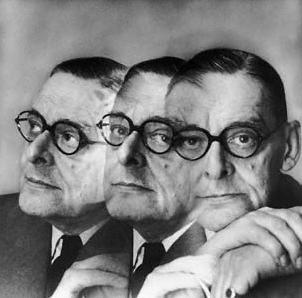
T. S. Eliot


From the Norton Anthology of English Literature (7th ed.):


Thomas Stearns Eliot was born in St. Louis, Missouri, of New England stock. He entered Harvard in 1906 and was influenced there by the anti-Romanticism of Irving Babbitt and the philosophical and critical interests of George Santayana, as well as by the enthusiasm that prevailed in certain Harvard circles for Elizabethan and Jacobean literature, the Italian Renaissance, and Indian mystical philosophy. His philosophical studies included intensive work on the English idealist philosopher F. H. Bradley, on whom he eventually wrote his Harvard dissertation. (Bradley's emphasis on the private nature of individual experience, "a circle enclosed on the outside," had considerable influence on the private imagery of Eliot's poetry and on the view of the relation between the individual and other individuals reflected in much of his poetry). Later, Eliot studied literature and philosophy in France and Germany, before going to England shortly after the outbreak of World War I in 1914. He studied Greek philosophy at Oxford, taught school in London, and then obtained a position with Lloyd's Bank. In 1915 he married an English writer, Vivienne Haigh-Wood, but the marriage was not a success. She was highly neurotic and in increasing bad health. The strain told on Eliot, too. By November 1921 distress and worry had brought him to the verge of a nervous breakdown, and on medical advice, he went to recuperate in a Swiss sanatorium. Two months later he returned, pausing in Paris long enough to give Ezra Pound the manuscript of The Waste Land. Eliot left his wife in 1933; and she was eventually committed to a mental home, where she died in 1947. Ten years later he married again and, for the eight years that remained to him, at last knew happiness.

Eliot started writing literary and philosophical reviews soon after settling in London. He wrote for the Atheaneum and the Times Literary Supplement, among other periodicals, and was assistant editor of the Egoist from 1917 to 1919. In 1922 he founded the influential quarterly Criterion, which he edited until it cesased publication in 1939. His poetry first appeared in 1915, when The Love Song of J. Alfred Profrock was printed in Poetry magazine (Chicago) and a few other short poems were published in the short-lived periodical Blast. His first published collection of poems was Prufrock and Other Observations, 1917; two other small collections followed in 1919 and 1920; in 1922 The Waste Land appeared, first in the Criterion in October, then in the Dial (in America) in November, and finally in book form. Poems 1909-25 (1925) collected these earlier poems. Meanwhile he was also publishing collections of his critical essays, notably The Sacred Wood in 1920 and Homage to John Dryden in 1924. For Lancelot Andrewes followed in 1928 and in 1932 lie included most of these earlier essays with some new ones in Selected Essays. In 1925 he joined the London publishing firm of Faber and Gwyer, becoming a director when the firm became Faber and Faber. He became a British subject and joined the Church of England in 1927.

"Our civilization comprehends great variety and complexity, and this variety and complexity, playing upon a refined sensibility, mut produce various and complex results. The poet must become more and more comprehensive, more allusive, more indirect, in order to force, to dislocate if necessary, language into his meaning." This remark, from Eliot's essay The Metaphysical Poets (1921), gives one clue to his poetic method from Prufrock through The Waste Land. In the tradition of the of the Georgian poets who were active when he settled in London, he saw an exhausted poetic mode being employed, with no verbal excitement or original craftsmanship. He sought to make poetry more subtle, more suggestive, and at the same time more precise. He had learned from the imagists the necessity of clear and precise images, and he learned, too, from the philosopher-poet T. E. Hulme and from his early supporter and adviser Ezra Pound to fear romantic softness and to regard the poetic medium rather than the poet's personality as the important factor. At the same time, the "hard, dry" images advocated by Hulme were not enough for him; he wanted wit, allusiveness, irony. He saw in the Metaphysical poets how wit and passion could be combined, and he saw in the French symbolists how an image could be both absolutely precise in what it referred to physically and at the same time endlessly suggestive in the meanings it set up because of its relationship to other images. The combination of precision, symbolic suggestion, and ironic mockery in the poetry of the late-nineteenth-century poet Jules Laforgue attracted and influenced him, and he was influenced too by other nineetenth-century French poets: by Théophile Gautier's artful carving of impersonal shapes of meaning, by Charles Baudelaire's strangely evocative explorations of the symbolic suggestions of objects and images; by the symbolist poets Paul Verlaine, Arthur Rimbaud, and Stéphane Mallarmé. He also found in the Jacobean dramatists a flexible blank verse with overtones of colloquial movement: Middleton, Tourneur, Webster, and others, taught him as much—in the way of verse movement, imagery, the counterpointing of the accent of conversation and the note of terror—as either the Metaphysicals or the French symbolists.

Hulme's protests against the Romantic concept of poetry fitted in well enough with what Eliot had learned from Irving Babbitt at Harvard, yet for all his severity with such poets as Shelley, for all his conscious cultivation of a classical viewpoint and his insistence on order and discipline rather than on mere self-expression in art, one side of Eliot's poetic genius is, in one sense of the word, Romantic. The symbolist influence on his imagery, his interest in the evocative and the suggestive, such lines as "And fiddled whisper music on those strings / And bats with baby faces in the violet light / Whistled, and beat their wings," and such recurring images as the hyacinth girl and the rose garden, all show what could be called a Romantic element in his poetry. But it is combined with a dry ironic allusivness, a play of wit, and a colloquial element, which are not normally found in poets of the Romantic tradition.

Eliot's real novelty—and the cause of such bewilderment when his poems first appeared—was his deliberate elimination of all merely connective and transitional passages, his building up of the total pattern of meaning through the immediate juxtaposition of images without overt explanation of what they are doing, together with his use of oblique references to other works of literature (some of them quite obscure to most readers of his time). Prufrock presents a symbolic landscape where the meaning emerges from the mutual interaction of the images, and that meaning is enlarged by echoes, often ironic, of Hesiod and Dante and Shakespeare. The Waste Land is a series of scenes and images with no author's voice intervening to tell us where we are, but with the implications developed through multiple contrasts and through analogies with older literary works often referred to in a distorted quotation or a half-concealed allusion. Furthermore, the works referred to are not necessarily works that are central in the Western literary tradition: besides Dante and Shakespeare there are pre-Socratic philosophers, minor (as well as major) seventeenth-century poets and dramatists; works of anthropology, history, and philosophy; and other echoes of the poet's private reading. In a culture where there is no longer any assurance on the part of the poet that his or her public has a common cultural heritage, a common knowledge of works of the past, Eliot felt it necessary to build up his own body of references. It is this that marks the difference between Eliot's use of earlier literature and, say, Milton's. Both poets are difficult to the modern reader, who needs editorial assistance in recognizing and understanding many of the allusions—but Milton was drawing on a body of knowledge common to educated people in his day. Nevertheless, this aspect of Eliot can be exaggerated: the fact remains that the nature of his imagery together with the movement of his verse generally succeed in setting the tone he requires, in establishing the area of meaning to be developed, so that even a reader ignorant of most of the literary allusions can often get the feel of the poem and achieve some understanding of what it says.

Eliot's early poetry, until at least the middle 1920s, is mostly concerned in one way or another with the Waste Land, with aspects of the decay of culture in the modern Western world. After his formal acceptance of Anglican Christianity we find a penitential note in much of his verse, a note of quiet searching for spiritual peace, with considerable allusion to biblical, liturgical, and mystical religious literature and to Dante. Ash Wednesday (1930), a poem in six parts, much less fiercely concentrated in style than the earlier poetry, explores with gentle insistence a mood both penitential and questioning. The so-called Ariel poems (the title has nothing to do with their form or content) present or explore aspects of religious doubt or discovery or revelation, sometimes, as in Marina, using a purely secular imagery and sometimes, as in Journey of the Magi, drawing on biblical incident. In Four Quartets (of which the first, Burnt Norton, appeared in the Collected Poems of 1935, though all four were not completed until 1943, when they were published together) Eliot further explored essentially religious moods, dealing with the relation between time and eternity and the cultivation of that selfless passivity that can yield the moment of timeless revelation in the midst of time. The mocking irony, the savage humor, the deliberately startling juxtapostion of the sordid and the romantic give way in these later poems to a quieter poetic idiom, often still completely allusive but never deliberately shocking.

Eliot's criticism was the criticism of a practicing poet who worked out in relation to his reading of older literature what he needed to hold and to admire. He lent the growing weight of his authority to that shift in literary taste that replaced Milton by Donne as the great seventeenth-century English poet and replaced tennyson in the nineteenthy century by Hopkins. His often-quoted description of the late seventeenth-century "dissociation of sensibility"—keeping wit and passion in separate compartments—which he saw as determining the course of English poetry throughout the eighteenth and nineteenth centuries, is both a contribution to the rewriting of English literary history and an explanation of what he was aiming at in his own poetry: the reestablishment of that unified sensibility he found in Donne and other early seventeenth-century poets and dramatists. His view of tradition, his dislike of the poetic exploitation of the author's own personality, his advocacy of what he called "orthodoxy," made him suspicious of what he considered eccentric geniuses such as Blake and D. H. Lawrence. On the other side, his dislike of the grandiloquent and his insistence on complexity and on the mingling of the formal with the conversational made him distrustful of the influence of Milton on English poets. He considered himself "classicist in literature, royalist in politics, and Anglo-Catholic in religion" (For Lancelot Andrewes, 1928), in favor of order against chaos, tradition against eccentricity, authority against rampant individualism; yet his own poetry is in many respects untraditional and certainly highly individual in tone. His conservative and even authoritarian habit of mind alienated some who admire—and some whose own poetry has been much influenced by—his poetry.

Eliot's plays have all been, directly or indirectly, on religious themes. Murder in the Cathedral (1935) deals with the murder of Archbishop Thomas à Becket in an appropriately ritual manner, with much use of a chorus and with the central speech in the form of a sermon by the archbishop in his cathedral shortly before his murder. The Family Reunion (1939) deals with the problem of guilt and redemption in a modern upper-class English family; it makes a deliberate attempt to combine choric devices from Greek tragedy with a poetic idiom subdued to the accents of drawing-room conversation. In his three later plays, all written in the 1950s, The Cocktail Party, The Confidential Clerk, and The Elder Statesman, he achieved popular success by casting a serious religious theme in the form of a sophisticated modern social comedy, using a verse that is so conversational in movement that when spoken in the theater it does not sound like verse at all.

Critics differ on the degree to which Eliot succeeded in his last plays in combining box-office success with dramatic effectiveness. But there is no disagreement on his importance as one of the great renovators of the English poetic dialect, whose influence on a whole generation of poets, critics, and intellectuals generally was enormous. His range as a poet is limited, and his interest in the great middle ground of human experience (as distinct from the extremes of saint and sinner) deficient, but when in 1948 he was awarded the rare honor of the Order of Merit by King George VI and also gained the Nobel Prize for Literature, his positive qualities weere widely and fully recognized—his poetic cunning, his fine craftsmanship, his original accent, his historical and representative importance, as the poet of the modern symbolist-Metaphysical tradition.


The Waste Land

This is a poem about spiritual dryness, about the kind of existence in which no regenerating belief gives significance and value to people's daily activities, sex brings no fruitfulness, and death heralds no resurrection. Eliot himself gives one of the main clues to the theme and structure of the poem in a general note, in which he stated that "not only the title, but the plan and a good deal of the symbolism of the poem were suggested by Miss Jessie L. Weston's book on the Grail Legend: From Ritual to Romance" (1920). He further acknowledged a general indebtedness to Sir James Frazer's Golden Bough (13 volumes, 1890-1915), "especially the . . . volumes Adonis, Attis, Osiris," in which Frazer deals with ancient vegetation myths and fertility ceremonies. Weston's study, drawing on material from Frazer and other anthropologists, traced the relationship of these myths and rituals to Christianity and most especially to the legend of the Holy Grail. She found an archetypal fertility myth in the story of the Fisher King whose death, infirmity, or impotence (there are many forms of the myth) brought drought and desolation to the land and failure of the power to reproduce themselves among both humans and beasts. This symbolic Waste Land can be revived only if a "questing knight" goes to the Chapel Perilous, situated in the heart of it, and there asks certain ritual questions about the Grail (or Cup) and the Lance—originally fertility symbols, female and male, respectively. The proper asking of these questions revives the king and restores fertility to the land. The relation of this original Grail myth to fertility cults and rituals found in many different civilizations, and represented by stories of a dying god who is later resurrected (e.g., Tammuz, Adonis, Attis) shows their common origin in a response to the cyclical movement of the seasons, with vegetation dying in winter to be resurrected again in the spring. Christianity, according to Weston, gave its own spiritual meaning to the myth; it "did not hesitate to utilize the already existing medium of instruction, but boldly identified the Deity of Vegetation, regarded as Life Principle, with the God of the Christian Faith." The Fisher King is related to the use of the fish symbol in early Christianity. Weston states "with certainty that the Fish is a Life symbol of immemorial antiquity, and that the title of Fisher has, from the earliest ages, been associated with the Deities whio were held to be specially connected with the origin and preservation of Life." Eliot, following Weston, thus uses a great variety of mythological and religious material, both Occidental and Oriental, to paint a symbolic picture of the modern Waste Land and the need for regeneration. The terror of that life—its loneliness, emptiness, and irrational apprehensions—as well as its misuses of sexuality are vividly presented, but paradoxically, the poem ends with a benediction. Another significant general source for the poem is the composer Richard Wagner, some of whose operas (Götterdämmerung ["Twilight of the Gods"], Parsifal, Rheingold, and Tristand and Isolde) are drawn on.

The poem as published owed a great deal to the severe pruning of Ezra Pound; the original manuscript, with Pound's excisions and comments, provides fascinating information about the genesis and development of the poem. It was reproduced in facsimile in 1971, edited by Eliot's widow, Valerie Eliot, who also supplied notes supplementing those that Eliot himself added when the poem was first published in book form in 1922 and that are included with the present editors' footnotes to the poem.


—oOo—

viernes, 11 de octubre de 2019

SECCIÓN B: Robert Frost


SECCIÓN B - (6) Literatura norteamericana moderna

ROBERT FROST    (1874-1963)

Robert Lee Frost, US poet, b. San Francisco; stayed in England 1912-15, friend of Edward Thomas; lived in New Hampshire, affiliated teacher at Amherst, Harvard and Michigan; unofficial US Laureate, invited to Kennedy's inauguration, died in Boston; popular as quintessential American poet of country life, colloquial tone, humanist individualist reflections on work, nature, character, and of life experience.


Works

Frost, Robert.
A Boy's Will. Poems. London, 1913.
_____. North of Boston.
Poems. London, 1914.
_____. "The Road Not Taken." Poem. In Frost, Mountain Interval. 1916.
_____. "Birches." Poem. In Frost,
Mountain Interval. 1916.
_____. Mountain Interval.
Poems. 1916.
_____. New Hampshire.
Poems. 1923. (Pulitzer Prize).
_____. Collected Poems.
1930. (Pulitzer Prize). 2nd ed. 1939.
_____. A Further Range.
1936. (Pulitzer Prize).
_____. A Witness Tree.
Poems. 1942. (Pulitzer Prize).
_____. In the Clearing.
Poems. 1962.


A few notes on Robert Frost, from the Oxford Companion to American Literature:
http://vanityfea.blogspot.com.es/2012/12/robert-frost.html


And one of his most famous poems: "Stopping by Woods on a Snowy Evening"


____________________


Robert Frost: NIVEL AVANZADO


Un blog sobre literatura inglesa (y norteamericana)

  Este blog fue utilizado como material auxiliar para una asignatura del grado de Lenguas Modernas en la Universidad de Zaragoza, asignatur...