Mostrando entradas con la etiqueta Modernism. Mostrar todas las entradas
Mostrando entradas con la etiqueta Modernism. Mostrar todas las entradas
martes, 27 de octubre de 2020
Nivel avanzado: Yeats
______________________________
SECCIÓN B, NIVEL AVANZADO: YEATS
A video lecture on W. B. Yeats by Langdon Hammer (Yale University):
http://youtu.be/ixs5AvKaB4E

viernes, 25 de octubre de 2019
Virginia Woolf - Bloomsbury and Beyond

Bloomsbury and Beyond:
From The Short Oxford History of English Literature, by Andrew Sanders:
When the narrator of Evelyn Waugh's Brideshead Revisited goes up to Oxford as an undergraduate in 1922 he decorates his college rooms with objects indicative of his 'advanced' but essentially derivative taste. Charles Ryder hangs up a reproduction of Van Gogh's Sunflowers, a painting which had been shown at the first Post-Impressionist exhibition, and he displays a screen painted by Roger Fry that he has acquired at the closing sale at Fry's pioneering Omega Workshops (a byword for the clumsily experimental interior design of the period). He also shows off a collection of books which he later embarrassedly describes as 'meagre and commonplace.' These books include volumes of Georgian Poetry (the last in the series of which had just appeared), once popular and mildly sensational novels by Compton Mackenzie (1883-1972) and Norman Douglas (1868-1952), Roger Fry's Vision and Design of 1920 and Lytton Strachey's Eminent Victorians of 1918. These last two volumes, issued in a similar popular format in the early 1920s, are the clearest signals of the extent to which the young Ryder has been influenced by the canons of taste enunciated by the group of writers and artists who have come to be known as the 'Bloomsbury Group'.
'Bloomsbury' was never a formal grouping. Its origins lay in male frienships in late nineteenth-century Cambridge; in the early 1900s it found a focus in the Gordon Square house of the children of Leslie Stephen in unfashionable Bloomsbury; it was only with the formation of the 'Memoir Club' in 1920 that it loosely defined the limits of its friendships, relationships, and sympathies. The 'Memoir Club' originally centred on Leslie Stephen's two daughters Virginia and Vanessa, their husbands Leonard Woolf and Clive Bell, and their friends and neighbours Desmond and Molly MacCarthy, Duncan Grant, E. M. Forster, Roger Fry, and John Maynard Keynes. The group was linked by what Clive Bell later called 'a taste for discussion in the pursuit of truth and a contempt for conventional ways of thinking and feeling, contempt for conventional morals if you will'. Their discussions combined tolerant agnosticism with cultural dogmatism, progressive rationality with social snobbery, practical jokes with refined self-advertisement. When in 1928 Bell (1881-1964) attempted to define 'Civilization' (in a book of that name) he identified an aggrandized Bloomsbury ideal in the douceur de vivre and witty iconoclasm of the France of the Enlightenment (though, as Virginia Woolf commented, 'in the end it turns out that civilization is a lunch party at No 50 Gordon Square'). To its friends 'Bloomsbury' offered a prevision of a relaxed, permissive and élitist future; to its enemies, like the once patronized and later estranged D. H. Lawrence, it was a tight little world peopled by upper-middle-class 'black beetles'.
The prime 'Bloomsbury' text, Lytton Strachey's Eminent Victorians, suggests that it is easier to see what the group did not represent than what it did. Strachey's book struck a sympathetic chord with both his friends and the public at large. Eminent Victorians (1918), a collection of four succint biographies of Cardinal Manning, Florence Nightingale, Thomas Arnold, and General Gordon, seemed to many readers to deliver the necessary coup de grâce to the false ideals and empty heroism of the nineteenth century. These were principles which seemed to have been tried on the Western Front and found disastrously wanting. Strachey (1880-1932) does not so much mock his subjects as let them damn themselves in the eyes of their more enlightened successors. He works not by frontal assault by by means of the sapping innuendo and the carefully placed, explosive epigram. His models, like Bell's, are the Voltaire and conversationalists of the Paris salons of the eighteenth century, not the earnest Carlylean lectures of Victorian London. When, for example, he speculates about Florence Nightingale's conception of God he jests that 'she felt towards Him as she might have felt towards a glorified sanitary engineer'. In a review written in 1909 Strachey had endorsed the idea that 'the first duty of a great historian is to be an artist'. As his later studies of Queen Victoria (1921) and of Elizabeth and Essex (1928) suggest, Strachey was neither a great historian nor, ultimately, a great biographer, but he was undoubtedly an innovative craftsman. The 'art' of biography has never been quite the same since. It is not simply that he was an iconoclast; he was the master of a prose of elegant disenchantment. His age, if it did not always cultivate elegance, readily understood disenchantment.
Strachey's biographies challenged the conventional wisdom of interpretation. They sprang, like the disparate essays assembled in Roger Fry's Vision and Design, from an urge to establish a new way of seeing and observing which was distinct from the stuffy pieties of the Victorians. Fry's title carefully avoids the word 'form', but it is that word, linked to the crucially qualifying adjective 'significant', which weaves, by direct reference and by implication, in and out of the twenty-five short essays. Although Vision and Design is primarily dedicated to reconsiderations of painting and sculpture, the implications of its theoretical formulations for the experimental fiction of Virginia Woolf are considerable. In his 'Essays in Aesthetics' Fry distinguishes between 'instinctive reactions to sensible objects' and the peculiarly human faculty of 'calling up again . . . the echo of past experiences' in the imagination. The 'whole consciousness', he argues, 'may be focussed upon the perceptive and the emotional aspects of the experience' and thus produced in the imaginative life 'a different set of values, and a different kind of perception'. As the 'chief organ of the imaginative life' Art works by a set of values distinct from those of pure representation. When he specifically returns to his argument in the book's final 'Retrospect' Fry offers a further definition of the term 'significant form' as 'something other than agreeable arrangements of form, harmonious patterns, and the like'. A work of art possessing this elusive, and seemingly indefinable quality implies, he asserts, 'the effort on the part of the artist to bend to our emotional understanding by means of his passionate conviction some intractable material which is alien to our spirit'.
Virginia Woolf's criticism distils and reapplies Bell's and Fry's aesthetic ideas as a means of arguing for the potential freedom of the novel from commonly received understandings of plot, time, and identity. In discussing the revision of traditional modes of representation in her essay 'Modern Fiction', Woolf (1882-1941) insists that each day 'the mind receives a myriad impressions—trivial, fantastic, evanescent, or engraved with the sharpness of steel'. The novelist, attempting to work with this 'incessant shower of innumerable atoms', is forced to recognize that 'if he could base his work upon his own feeling and not upon convention', there would be no plot, no comedy, no tragedy, no love interest or catastrophe 'in the accepted style'. The task of the future novelist, Woolf therefore suggests, is to convey an impression of the 'luminous halo' of life—'this varying, this unknown and uncircumscribed spirit'—with as little mixture of the 'alien and external' as possible. What Woolf seeks to defend in her essays is not necessarily a new range of subjects for the novel, but new ways of rendering and designing the novel. She does more than present a challenge to the received idea of realism; she reaches out to a new aesthetic of realism. Essentially, she defines her own work, and that of contermporaries, such as Lawrence and Joyce, against the example of the Edwardian 'materialists' (and Arnold Bennett in particular) who, to her mind, laid too great a stress on 'the fabric of things'. Not only did they weigh their fiction down with a plethora of external detail, they too readily accepted the constraints of conventional obedience to 'plot' and sequential development. Much as Roger Fry had seen the liberated artist 'bending' intractable material into significance, Woolf insists that the twentieth-century novelist could evolve a new fictional form out of a representation of the 'myriad impressions' which daily impose themselves on the human consciousness.
As Virginia Woolf's fictional style developed beyond the relatively conventional parameters of The Voyage Out (1915) to the experimental representations of consciousness in Mrs Dalloway (1925), To the Lighthouse (1927), and The Waves (1931), specific characterization recedes and the detailed exploration of the individual identity tends to melt into a larger and freer expression. The discontinuities, fragmentations, and disintegrations which her avant-garde artistic contemporaries observed in both the external and the spiritual world become focused for Woolf in the idea, noted in her diary in 1924, of character 'dissipated into shreds'. Her novels attempt both to 'dissipate' character and to reintegrate human experience within an aesthetic shape or 'form'. She seeks to represent the nature of transient sensation, or of conscious and unconscious mental activity, and then to relate it outwards to a more universal awareness of pattern and rhythm. The momentary reaction, the impermanent emotion, the ephemeral stimulus, the random suggestion, and the dissociated thought are effectively 'bent' into a stylistic relationship to something coherent and structured. A 'coherence in things' is what Mrs Ramsay recognizes in a visionary, and quasi-religious, moment of peace in To the Lighthouse as 'as stability . . . something . . . immune from change'. The supposedly random picture of the temporal in Woolf's later fiction is also informed and 'interpreted' by the invocation of the permanent and universal, much as the 'arbitrary' in nature was 'interpreted' with reference to post-Darwinian science, or the complexities of the human psyche unravelled by the application of newly fashionable Freudian theory. Although her characters may often seem to be dissolved into little more than ciphers, what they come to signify is part of a complex iconographic discourse. In the instances of To the Lighthouse and The Waves the glancing insights into the identities of characters are complemented by larger symbols (a flickering lightouse or moving water) which are allowed to be both temporary and permanent, both 'real' and resonant, both constant and fluctuating. The fictional whole thus become a normative expression of certain Modernist themes and modes. Woolf's particular preoccupation with time is closely related to her manifest interest in flux, a dissolution or dissipation of distinctions within a fluid pattern of change and decay, which she recognizes in nature and science as much as in the human psyche.
The informing presence of women characters with an aesthetic propensity, or of particular women artists, serves to moderate and condition the larger ambitions of the narratives in which they appear. Although Virginia Woolf rarely directly echoes the insistent narrative voice of a George Eliot, her own work does reflect what she recognized in her pioneer essay on Eliot (1925) as a tendency to introduce characters who stand for 'that troubled spirit, that exacting and questioning and baffled presence' of the novelist herself. If neither Lily Briscoe nor Miss La Trobe possess the cultural significance of a Romola or a Dorothea, both are allowed, as amateur artists, to act out the ordering dilemma of the professional. In the final part of To the Lighthouse the 'weight' of Lily Briscoe's painting seems to be poised as she explores the elusive nature of mass and form: 'Beautiful and bright it should be on the surface, feathery and evanescent, one colour melting into another like the colours on a butterfly's wing; but beneath the fabric must be clamped together with bolts of iron.' A similar 'visionary' insight temporarily enlightens the amateur author of the historical pageant around which Between the Acts (1941) is shaped. Miss La Trobe watches entranced as butterflies (traditional images of the human soul) 'gluttonously absorb' the rich colours of the fancy dress strewn on the grass; the possibility of a completer art briefly dawns on her, only to fall apart again. In both novels women's sensibility (and sensitivity) constrasts with the factual 'materialism' of a world dominated by the kind of men who 'negotiated treaties, ruled India, controlled finance' or who insist, as Colonel Mayhew does in Between the Acts, that no picture of history is complete without reference to the British Army. The Mrs Ramsays, the Lily Briscoes, and the Miss La Trobes dream their brief dreams or are vouchsafed momentary 'epiphanies'; the men are often left content with a limited grasp, and presumed control, of the physical world.
Virginia Woolf's most complete, but ambiguous, representation of the life of a woman character's mind in Mrs Dalloway is also her most thorough experiment with the new technique of interior monologue. The novel plays subtly with the problem of an identity which is both multiple and singular, both public and private, and it gradually insists on the mutual dependence and opposition of the perceptions of Clarissa Dalloway and the shell-shocked ramblings of a victim of the war, Septimus Warren Smith. Mrs Dalloway reveals both the particular originality of Woolf's fictional mode and the more general limitations of her social vision. When she returns to the problem of a dissipated identity in her extraordinary tribute to the English aristocracy, Orlando (1928), she seems to seek both to dissolve and define character in a fanciful concoction of English history nad shifting gender. The book is in part a sentimental tribute to the personal flair and ancestral fixation of her aristocratic friend and fellow-writer, Victoria ('Vita') Sackville-West (1892-1962), in part an exploration of a 'masculine' freedom traditionally denied to women. If Woolf's depiction of the society of her time is as blinkered as that of E. M. Forster by upper-middle-class snobberies and would-be liberalisms, the historical perspective which determined her feminism made for a far more distinctive clarity of argument. In the essay 'Street Haunting' (published in 1942) she writes of the pleasures of a London flâneuse who discovers as the front door shuts that the shell-like nature of domestic withdrawal is broken open 'and there is left of all these wrinkles and roughnesses a central oyster of perceptiveness, an enormous eye'. Almost the opposite process is delineated in the study A Room of One's Own (1929), where the existence of a private space, and of a private income, is seen as a prerequisite for the development of a woman writer's creativity. A Room of One's Own is, however, far more than an insistent plea for privacy, leisure, and education; it is a proclamation that women's writing has nearly come of age. It meditates on the pervasiveness of women as the subjects of poetry and on their absence from history; it plays as fancifully as the narrator of Orlando might with the domestic fate of a woman Shakespeare, but above all it pays tribute to those English novelists, from Aphra Behn to George Eliot, who established a tradition of women's writing. 'Masterpieces are not single and solitary births', she insisted, 'they are the outcome of many years of thinking in common, of thinking by the body of the people, so that the experience of the mass is behind the single voice.' It is in this tradition that Virginia Woolf most earnestly sought to see herself, a tradition which to her would eventually force open a way for the woman writer to see human beings 'not always in relation to each otehr but in relation to reality; and to the sky, too, and the trees or whatever it may be in themselves'.
Woolf's 'significant forms', shaped from glancing insights and carefully placed and iterated details, are to some degree echoed in the work of her New Zealand-born contemporary, Katherine Mansfield (the pseudonym of Kathleen Mansfield Beauchamp, 1888-1923). If Mansfield's success with reviewers and readers seems to have stimulated Woolf's jealousy rather than critical generosity (Woolf generally found Mansfield 'inscrutable'), both writers can be seen as developing the post-impressionist principle of suggestiveness and rhythm from a distinctively feminine point of view. Mansfield worked determinedly on a small scale, concentrating on carefully pointed, delicately elusive short stories. Her succint narratives, collected as In a German Pension (1911), Bliss, and Other Stories (1920), and The Garden Party, and Other Stories (1922), are brief triumphs of style, as style which serves both to suggest a pervasive atmosphere and to establish a series of evanescent sensations (creaks, yawns, draughts, cries, footfalls, bird-calls, and cat's miaows). Where In a German Pension conveys a fastidious dislike of Teutonic manners and mannerisms (though Mansfield declined to have the volume reprinted during the Great War), her later stories move towards a greater technical mastery and to a larger world-view. She draws significantly on the landscapes and flora of her native New Zealand (in, for example, 'The Aloe'), she attempts to explore the responses of a wide spectrum of social types, and, by means of a style which takes on a yet more shimmering elusiveness, she endeavours to describe the mysterious 'diversity of life . . . Death included'. Her own untimely death from tuberculosis cut short a remarkable innovative career.
—oOo—
Virginia Woolf (NIVEL AVANZADO)
SECCIÓN B, NIVEL AVANZADO - VIRGINIA WOOLF
Virginia Woolf. Un documental sobre su vida en YouTube:
— y una película basada en su novela Mrs.
Dalloway, con Vanessa Redgrave.
Sobre la figura de Virginia Woolf podéis ver también la
película The Hours
(2002), un homenaje a la autora basado en una novela de Michael
Cunningham—es más que recomendable, pero totalmente fuera de programa,
por
supuesto.
Un comentario de un pasaje de A Room
of One's Own, un
momento de reflexión sobre la mente andrógina y otro sobre el
estilo de Woolf y su uso del tiempo
tan característico de la novela modernista.
__________
viernes, 18 de octubre de 2019
T. S. Eliot
From the Norton Anthology of English
Literature (7th ed.):
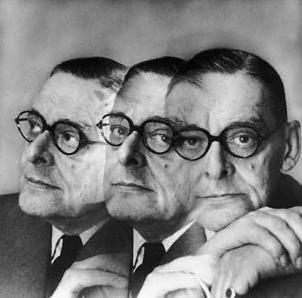
Thomas Stearns Eliot was born in St. Louis, Missouri, of New England stock. He entered Harvard in 1906 and was influenced there by the anti-Romanticism of Irving Babbitt and the philosophical and critical interests of George Santayana, as well as by the enthusiasm that prevailed in certain Harvard circles for Elizabethan and Jacobean literature, the Italian Renaissance, and Indian mystical philosophy. His philosophical studies included intensive work on the English idealist philosopher F. H. Bradley, on whom he eventually wrote his Harvard dissertation. (Bradley's emphasis on the private nature of individual experience, "a circle enclosed on the outside," had considerable influence on the private imagery of Eliot's poetry and on the view of the relation between the individual and other individuals reflected in much of his poetry). Later, Eliot studied literature and philosophy in France and Germany, before going to England shortly after the outbreak of World War I in 1914. He studied Greek philosophy at Oxford, taught school in London, and then obtained a position with Lloyd's Bank. In 1915 he married an English writer, Vivienne Haigh-Wood, but the marriage was not a success. She was highly neurotic and in increasing bad health. The strain told on Eliot, too. By November 1921 distress and worry had brought him to the verge of a nervous breakdown, and on medical advice, he went to recuperate in a Swiss sanatorium. Two months later he returned, pausing in Paris long enough to give Ezra Pound the manuscript of The Waste Land. Eliot left his wife in 1933; and she was eventually committed to a mental home, where she died in 1947. Ten years later he married again and, for the eight years that remained to him, at last knew happiness.
Eliot started writing literary and philosophical reviews soon after settling in London. He wrote for the Atheaneum and the Times Literary Supplement, among other periodicals, and was assistant editor of the Egoist from 1917 to 1919. In 1922 he founded the influential quarterly Criterion, which he edited until it cesased publication in 1939. His poetry first appeared in 1915, when The Love Song of J. Alfred Profrock was printed in Poetry magazine (Chicago) and a few other short poems were published in the short-lived periodical Blast. His first published collection of poems was Prufrock and Other Observations, 1917; two other small collections followed in 1919 and 1920; in 1922 The Waste Land appeared, first in the Criterion in October, then in the Dial (in America) in November, and finally in book form. Poems 1909-25 (1925) collected these earlier poems. Meanwhile he was also publishing collections of his critical essays, notably The Sacred Wood in 1920 and Homage to John Dryden in 1924. For Lancelot Andrewes followed in 1928 and in 1932 lie included most of these earlier essays with some new ones in Selected Essays. In 1925 he joined the London publishing firm of Faber and Gwyer, becoming a director when the firm became Faber and Faber. He became a British subject and joined the Church of England in 1927.
"Our civilization comprehends great variety and complexity, and this variety and complexity, playing upon a refined sensibility, mut produce various and complex results. The poet must become more and more comprehensive, more allusive, more indirect, in order to force, to dislocate if necessary, language into his meaning." This remark, from Eliot's essay The Metaphysical Poets (1921), gives one clue to his poetic method from Prufrock through The Waste Land. In the tradition of the of the Georgian poets who were active when he settled in London, he saw an exhausted poetic mode being employed, with no verbal excitement or original craftsmanship. He sought to make poetry more subtle, more suggestive, and at the same time more precise. He had learned from the imagists the necessity of clear and precise images, and he learned, too, from the philosopher-poet T. E. Hulme and from his early supporter and adviser Ezra Pound to fear romantic softness and to regard the poetic medium rather than the poet's personality as the important factor. At the same time, the "hard, dry" images advocated by Hulme were not enough for him; he wanted wit, allusiveness, irony. He saw in the Metaphysical poets how wit and passion could be combined, and he saw in the French symbolists how an image could be both absolutely precise in what it referred to physically and at the same time endlessly suggestive in the meanings it set up because of its relationship to other images. The combination of precision, symbolic suggestion, and ironic mockery in the poetry of the late-nineteenth-century poet Jules Laforgue attracted and influenced him, and he was influenced too by other nineetenth-century French poets: by Théophile Gautier's artful carving of impersonal shapes of meaning, by Charles Baudelaire's strangely evocative explorations of the symbolic suggestions of objects and images; by the symbolist poets Paul Verlaine, Arthur Rimbaud, and Stéphane Mallarmé. He also found in the Jacobean dramatists a flexible blank verse with overtones of colloquial movement: Middleton, Tourneur, Webster, and others, taught him as much—in the way of verse movement, imagery, the counterpointing of the accent of conversation and the note of terror—as either the Metaphysicals or the French symbolists.
Hulme's protests against the Romantic concept of poetry fitted in well enough with what Eliot had learned from Irving Babbitt at Harvard, yet for all his severity with such poets as Shelley, for all his conscious cultivation of a classical viewpoint and his insistence on order and discipline rather than on mere self-expression in art, one side of Eliot's poetic genius is, in one sense of the word, Romantic. The symbolist influence on his imagery, his interest in the evocative and the suggestive, such lines as "And fiddled whisper music on those strings / And bats with baby faces in the violet light / Whistled, and beat their wings," and such recurring images as the hyacinth girl and the rose garden, all show what could be called a Romantic element in his poetry. But it is combined with a dry ironic allusivness, a play of wit, and a colloquial element, which are not normally found in poets of the Romantic tradition.
Eliot's real novelty—and the cause of such bewilderment when his poems first appeared—was his deliberate elimination of all merely connective and transitional passages, his building up of the total pattern of meaning through the immediate juxtaposition of images without overt explanation of what they are doing, together with his use of oblique references to other works of literature (some of them quite obscure to most readers of his time). Prufrock presents a symbolic landscape where the meaning emerges from the mutual interaction of the images, and that meaning is enlarged by echoes, often ironic, of Hesiod and Dante and Shakespeare. The Waste Land is a series of scenes and images with no author's voice intervening to tell us where we are, but with the implications developed through multiple contrasts and through analogies with older literary works often referred to in a distorted quotation or a half-concealed allusion. Furthermore, the works referred to are not necessarily works that are central in the Western literary tradition: besides Dante and Shakespeare there are pre-Socratic philosophers, minor (as well as major) seventeenth-century poets and dramatists; works of anthropology, history, and philosophy; and other echoes of the poet's private reading. In a culture where there is no longer any assurance on the part of the poet that his or her public has a common cultural heritage, a common knowledge of works of the past, Eliot felt it necessary to build up his own body of references. It is this that marks the difference between Eliot's use of earlier literature and, say, Milton's. Both poets are difficult to the modern reader, who needs editorial assistance in recognizing and understanding many of the allusions—but Milton was drawing on a body of knowledge common to educated people in his day. Nevertheless, this aspect of Eliot can be exaggerated: the fact remains that the nature of his imagery together with the movement of his verse generally succeed in setting the tone he requires, in establishing the area of meaning to be developed, so that even a reader ignorant of most of the literary allusions can often get the feel of the poem and achieve some understanding of what it says.
Eliot's early poetry, until at least the middle 1920s, is mostly concerned in one way or another with the Waste Land, with aspects of the decay of culture in the modern Western world. After his formal acceptance of Anglican Christianity we find a penitential note in much of his verse, a note of quiet searching for spiritual peace, with considerable allusion to biblical, liturgical, and mystical religious literature and to Dante. Ash Wednesday (1930), a poem in six parts, much less fiercely concentrated in style than the earlier poetry, explores with gentle insistence a mood both penitential and questioning. The so-called Ariel poems (the title has nothing to do with their form or content) present or explore aspects of religious doubt or discovery or revelation, sometimes, as in Marina, using a purely secular imagery and sometimes, as in Journey of the Magi, drawing on biblical incident. In Four Quartets (of which the first, Burnt Norton, appeared in the Collected Poems of 1935, though all four were not completed until 1943, when they were published together) Eliot further explored essentially religious moods, dealing with the relation between time and eternity and the cultivation of that selfless passivity that can yield the moment of timeless revelation in the midst of time. The mocking irony, the savage humor, the deliberately startling juxtapostion of the sordid and the romantic give way in these later poems to a quieter poetic idiom, often still completely allusive but never deliberately shocking.
Eliot's criticism was the criticism of a practicing poet who worked out in relation to his reading of older literature what he needed to hold and to admire. He lent the growing weight of his authority to that shift in literary taste that replaced Milton by Donne as the great seventeenth-century English poet and replaced tennyson in the nineteenthy century by Hopkins. His often-quoted description of the late seventeenth-century "dissociation of sensibility"—keeping wit and passion in separate compartments—which he saw as determining the course of English poetry throughout the eighteenth and nineteenth centuries, is both a contribution to the rewriting of English literary history and an explanation of what he was aiming at in his own poetry: the reestablishment of that unified sensibility he found in Donne and other early seventeenth-century poets and dramatists. His view of tradition, his dislike of the poetic exploitation of the author's own personality, his advocacy of what he called "orthodoxy," made him suspicious of what he considered eccentric geniuses such as Blake and D. H. Lawrence. On the other side, his dislike of the grandiloquent and his insistence on complexity and on the mingling of the formal with the conversational made him distrustful of the influence of Milton on English poets. He considered himself "classicist in literature, royalist in politics, and Anglo-Catholic in religion" (For Lancelot Andrewes, 1928), in favor of order against chaos, tradition against eccentricity, authority against rampant individualism; yet his own poetry is in many respects untraditional and certainly highly individual in tone. His conservative and even authoritarian habit of mind alienated some who admire—and some whose own poetry has been much influenced by—his poetry.
Eliot's plays have all been, directly or indirectly, on religious themes. Murder in the Cathedral (1935) deals with the murder of Archbishop Thomas à Becket in an appropriately ritual manner, with much use of a chorus and with the central speech in the form of a sermon by the archbishop in his cathedral shortly before his murder. The Family Reunion (1939) deals with the problem of guilt and redemption in a modern upper-class English family; it makes a deliberate attempt to combine choric devices from Greek tragedy with a poetic idiom subdued to the accents of drawing-room conversation. In his three later plays, all written in the 1950s, The Cocktail Party, The Confidential Clerk, and The Elder Statesman, he achieved popular success by casting a serious religious theme in the form of a sophisticated modern social comedy, using a verse that is so conversational in movement that when spoken in the theater it does not sound like verse at all.
Critics differ on the degree to which Eliot succeeded in his last plays in combining box-office success with dramatic effectiveness. But there is no disagreement on his importance as one of the great renovators of the English poetic dialect, whose influence on a whole generation of poets, critics, and intellectuals generally was enormous. His range as a poet is limited, and his interest in the great middle ground of human experience (as distinct from the extremes of saint and sinner) deficient, but when in 1948 he was awarded the rare honor of the Order of Merit by King George VI and also gained the Nobel Prize for Literature, his positive qualities weere widely and fully recognized—his poetic cunning, his fine craftsmanship, his original accent, his historical and representative importance, as the poet of the modern symbolist-Metaphysical tradition.
The Waste Land
This is a poem about spiritual dryness, about the kind of existence in which no regenerating belief gives significance and value to people's daily activities, sex brings no fruitfulness, and death heralds no resurrection. Eliot himself gives one of the main clues to the theme and structure of the poem in a general note, in which he stated that "not only the title, but the plan and a good deal of the symbolism of the poem were suggested by Miss Jessie L. Weston's book on the Grail Legend: From Ritual to Romance" (1920). He further acknowledged a general indebtedness to Sir James Frazer's Golden Bough (13 volumes, 1890-1915), "especially the . . . volumes Adonis, Attis, Osiris," in which Frazer deals with ancient vegetation myths and fertility ceremonies. Weston's study, drawing on material from Frazer and other anthropologists, traced the relationship of these myths and rituals to Christianity and most especially to the legend of the Holy Grail. She found an archetypal fertility myth in the story of the Fisher King whose death, infirmity, or impotence (there are many forms of the myth) brought drought and desolation to the land and failure of the power to reproduce themselves among both humans and beasts. This symbolic Waste Land can be revived only if a "questing knight" goes to the Chapel Perilous, situated in the heart of it, and there asks certain ritual questions about the Grail (or Cup) and the Lance—originally fertility symbols, female and male, respectively. The proper asking of these questions revives the king and restores fertility to the land. The relation of this original Grail myth to fertility cults and rituals found in many different civilizations, and represented by stories of a dying god who is later resurrected (e.g., Tammuz, Adonis, Attis) shows their common origin in a response to the cyclical movement of the seasons, with vegetation dying in winter to be resurrected again in the spring. Christianity, according to Weston, gave its own spiritual meaning to the myth; it "did not hesitate to utilize the already existing medium of instruction, but boldly identified the Deity of Vegetation, regarded as Life Principle, with the God of the Christian Faith." The Fisher King is related to the use of the fish symbol in early Christianity. Weston states "with certainty that the Fish is a Life symbol of immemorial antiquity, and that the title of Fisher has, from the earliest ages, been associated with the Deities whio were held to be specially connected with the origin and preservation of Life." Eliot, following Weston, thus uses a great variety of mythological and religious material, both Occidental and Oriental, to paint a symbolic picture of the modern Waste Land and the need for regeneration. The terror of that life—its loneliness, emptiness, and irrational apprehensions—as well as its misuses of sexuality are vividly presented, but paradoxically, the poem ends with a benediction. Another significant general source for the poem is the composer Richard Wagner, some of whose operas (Götterdämmerung ["Twilight of the Gods"], Parsifal, Rheingold, and Tristand and Isolde) are drawn on.
The poem as published owed a great deal to the severe pruning of Ezra Pound; the original manuscript, with Pound's excisions and comments, provides fascinating information about the genesis and development of the poem. It was reproduced in facsimile in 1971, edited by Eliot's widow, Valerie Eliot, who also supplied notes supplementing those that Eliot himself added when the poem was first published in book form in 1922 and that are included with the present editors' footnotes to the poem.
—oOo—
Drama, Eliot, Modernism (NIVEL AVANZADO)
Tema 6:
SECCIÓN B, NIVEL AVANZADO:
English Drama from Congreve to Eliot: http://vanityfea.blogspot.com.es/2014/11/drama-from-beginning-of-eighteenth.html
A BBC audio on literary modernism:
http://www.bbc.co.uk/programmes/p00547fv
And some additional notes on Eliot as a critic: Modernist poetry and criticism (T.S. Eliot).
___________________________________
viernes, 4 de octubre de 2019
James Joyce (Nivel avanzado)
SECCIÓN B (Tema 6)
James Joyce, NIVEL AVANZADO:
- Is There Anyone Who Understands Me? The Life and Work of James Joyce (documentary)
- Hace poco hubo un
ciclo sobre James Joyce en el Teatro de las Esquinas
(Zaragoza). Pueden verse vídeos en YouTube.
- Una conferencia de Jorge Luis Borges sobre Joyce.
James Joyce: ULYSSES.
Un documental/adaptación sobre la novela:
ULYSSES (film version, 1967). The Molly Bloom monologue.
—oOo—
Suscribirse a:
Entradas (Atom)
-
Este blog fue utilizado como material auxiliar para una asignatura del grado de Lenguas Modernas en la Universidad de Zaragoza, asignatur...
-
An introduction to Beowulf. Basic facts from The Oxford Companion to English Literature, f ollowed by some introductory study guide videos....
-
Some notes on John Donne (from The Penguin Short History of English Literature, by Stephen Coote; 1993; "From Donne to Dryden",...
