Mostrando entradas con la etiqueta Modern English poetry. Mostrar todas las entradas

sábado, 30 de octubre de 2021

6. SECCIÓN B


UNIT 6: LITERATURA INGLESA Y NORTEAMERICANA 1900-1960


SECCIÓN B, 

TEMA 6: LITERATURA INGLESA Y NORTEAMERICANA 1900-1960


_______________

 NIVEL AVANZADO: 

Un autor norteamericano muy popular de principios del siglo XX  que nos cae fuera del programa es Jack London.  Se estrenó hace poco una película inspirada en una de sus novelas, Martin Eden.

Martin Eden. Dir. Pietro Marcello. Based on Jack London's novel. Italy/France, 2019.

https://www.imdb.com/title/tt4516162/

De Jack London es especialmente memorable su relato sobre una pandemia apocalíptica, "The Scarlet Plage". Su interés va más allá de lo meramente literario. Aquí puede leerse algo más sobre Jack London y la epidemiología evolutiva.


OTROS AUTORES NORTEAMERICANOS 1900-1960

_______________


Recordad que ya podéis ir leyendo y estudiando los textos de esta sección, que están en la segunda parte de vuestro bloque de fotocopias. Para dudas y consultas sobre ellos y sobre los autores de la sección B, podéis anotarlas y enviármelas por correo a garciala@unizar.es


En este tema 6 tratamos (en orden inverso, empezando por abajo) autores ingleses y norteamericanos de principios y mediados del siglo XX. Seguidamente pasamos al tema 7, Literatura inglesa 1960-2000. 


_____________


Richard Gray on Nabokov.

Terminamos el TEMA 6 con unas notas sobre Vladimir Nabokov, clásico moderno de dos idiomas, ruso e inglés, 

—y con una panorámica sobre Samuel Beckett, otro clásico bilingüe en inglés y francés:


SAMUEL BECKETT         (1906-1989)

Anglo-Irish and French modernist bilingual writer, conservative bourgeois family, born in Foxrock, Ireland; studied at Portora School, Trinity College Dublin, and the Sorbonne; lived in Ireland, then Paris; loved cousin Peggy Sinclair;  bohemian lifestyle, expatriate skeptic vs. Catholic tradition; admirer and assistant of James Joyce in the 30s; m. Suzanne Deschevaux-Dumesnil; member of the Resistance, lived in hiding in Roussillon during 2nd WW; experimental writer and dramatist in English and French, world success as "absurdist" dramatist with Waiting for Godot; developed an ascetic aesthetics of impotence, decay, minimalism and impoverishment, writing ever shorter and denser works;  Nobel Prize 1969; international success but reclusive character; often directed his own plays; lived and died in Paris)

_____. En attendant Godot / Waiting for Godot. Drama, 1951. 1954.
_____. Molloy. Novel. 1951. In English,1955.
_____. Malone meurt / Malone Dies. Novel. 1951. 1956.
_____. L'Innommable / The Unnamable. Novel. 1954. 1958.
_____. Fin de partie /Endgame. Drama. 1954. 1958.
_____. Krapp's Last Tape / La Dernière bande. Drama. 1958. 1959.
_____. Happy Days / Oh les beaux jours. Drama. 1961. 1963.
_____. Play / Comédie. Drama. 1963. 1964.
_____. Not I / Pas moi. Drama. 1973. 1975 

______. Stirrings Still (Soubresauts). Prose. 1988. 1989.


- The New Drama: Beckett and Osborne (Andrew Sanders).

- "Samuel Beckett." In Wikipedia: The Free Encyclopedia.*
    http://en.wikipedia.org/wiki/Samuel_Beckett

- En YouTube se pueden ver varias obras de Beckett. Por ejemplo, Catastrophe.  O la que hemos incluido como lectura obligatoria,
Krapp's Last Tape.

____________________

 
NIVEL AVANZADO: 

- Un audio en français sur Beckett: Une vie, une œuvre.

- Samuel Beckett's experimental fiction, in THE NEW NOVELISTS OF THE 1950s.

- Vladimir Nabokov: A documentary and a lecture on Lolita.


________________________


________________________


E. E. CUMMINGS     (1894-1962)

Edward Estlin Cummings, US man of letters, modernist poet, dramatist and novelist; b. Cambridge, MA; grad. Harvard, Master of Arts 1916, ambulance volonteer in France, unjustly accused of treasonable correspondence 1st WW, defender of individualism and creative eccentricity vs. social regimentation, 20th-c. Transcendentalist.


Works

Cummings, E. E. The Enormous Room. Narrative. 1922.
_____. Tulips and Chimneys. Poems. 1923.
_____. &. 1925.
_____. is 5.  Poems. 1926.
_____. ViVa. 1931.
_____. (Untitled work). 1930.
_____. Eimi. 1933.
_____. Tom. 1935. (Satirical ballet based on Harriet Beecher Stowe's Uncle Tom's Cabin).
_____. No Thanks. 1935.
_____. 50 Poems. 1940.
_____. I x I. 1944.
_____ . XAIPE.  1950.
_____. Poems: 1924-1954. 1954.
_____. 95 Poems. 1958.
_____. 73 Poems. 1963. (Posth.).
_____.  Complete Poems, 1904-62.   1993.


- Unas notas sobre el poeta modernista norteamericano e. e. cummings.


Y otro poeta modernista inglés. Notas clicando en su nombre:


W. H.  AUDEN     (1907-1973)

Wystan Hugh Auden, modernist English poet, born in York; anglo-catholic family; studied at Gresham's School, Holt and Christ Church, Oxford;  homosexual, 1928 stay in Berlin with Isherwood, 1930s taught in Scotland and Downs School, Birmingham; professional writer late 30s, leftist sympathies before the war, turned conservative thereafter, cultivated Christian humanism and literary tradition; trips to Spanish War and China; expatriate in US 1939; US citizen c. 1946, lived half-year in Europe and USA with
life partner Chester Kallman in New York; summer stays in Ischia and Kirschtetten; honorary Professor of Poetry U of Oxford, 1956-60s; died in Vienna.

Auden, W. H.  Poems. 1930.
_____. Look, Stranger! Poems.  1936.
_____. "Spain 1937." Poem. 1937, 1940.
_____. "In Memory of W. B. Yeats." Poem. 1939.
_____. "In Time of War." Sonnet sequence. 1939.
_____. Another Time. Poems.  1940.
_____. New Year Letter. Poems. 1941.
_____. The Age of Anxiety. Poems. 1947.
_____. The Shield of Achilles. Poems. 1955.
_____. Homage to Clio. Poems. 1960.

_____. About the House. Poems. 1965.
_____. Los señores del límite: Selección de poemas y ensayos (1927-1973). 2007.


____________________________________________


Sección B, NIVEL AVANZADO:

- Dos influyentes críticos de la sociedad moderna y sus tendencias distópicas: Huxley y Orwell

—muy relevantes los dos en la era 2020.

Introducción a 1984 de Orwell 


La distopía de Orwell se hace realidad.


- Un documentaire, en français, sur Le meilleur des mondes et 1984— ...aujourd'hui.


-  Orwell en España: Rebelión en la pocilga


                                           ___________


Los poemas de Sylvia Plath, poeta feminista y suicida.


- Dylan Thomas, poeta galés, recita uno de sus poemas en la radio.


________________________
__________________ 


WILLIAM FAULKNER        (1897-1962)


_____.  Soldier's Pay. Novel. 1926.
_____. Mosquitoes. 1927.
_____. Sartoris. Novel. 1929.
_____. The Sound and the Fury. Novel. 1929.
_____. As I Lay Dying. Novel. 1930.
_____. "A Rose for Emily." Story. 1930.
    http://www.eng.fju.edu.tw/English_Literature/Rose/el-text-E-Rose.htm
    2012
_____. Sanctuary. Novel. New York: Random House, 1931.
_____. Light in August.  Novel. 1932.
_____. Pylon. Novel. 1935.
_____. Absalom, Absalom! 1936.
_____. The Wild Palms. Novel. 1939.
_____. The Hamlet. Novel. 1940. (Vol. 1 of the Snopes trilogy).
_____. The Big Sleep. Film script based on Raymond Chandler's novel. 1946.
_____. Go Down, Moses. Stories / novel. 1942.
_____. Collected Stories of William Faulkner. 1950.
_____. Requiem for a Nun. Novel. 1951.
_____. A Fable. Novel. 1954.
_____. The Town. Novel. 1957. (Vol. 2 of the Snopes trilogy).
_____. The Mansion. Novel. 1959. (Vol. 3 of the Snopes trilogy).

William Faulkner was a US southern writer, major modernist novelist and story writer; b. William Harrison Falkner in New Albany, Mississippi; l. Oxford, Lafayette county; Nobel Prize for Literature 1949; Pulitzer Prize 1955, 1962; d. Byhalia, Mississipi. He is best known for his complex narrative style involving the memories and mental worlds of characters, and for his portraits of Southern society. Faulkner's South is scarred by the legacies of racism and slavery, with deep-set social divisions as traditional rural communities both decay and endure amid twentieth-century disruptions.


ON FAULKNER'S  NOVEL THE SOUND AND THE FURY.


An introduction to Hemingway and Faulkner  (by Richard Gray)
http://vanityfea.blogspot.com.es/2012/12/hemingway-and-faulkner.html


____________________________________


ERNEST HEMINGWAY      (1899-1961)

_____.  In Our Time. Stories. 1925.
_____. The Sun Also Rises. Novel. 1926. (= Fiesta)
_____. Men Without Women. Stories. 1927.
_____. A Farewell to Arms. Novel. 1929.
_____. Death in the Afternoon. Essay. 1932.
_____. Winner Take Nothing. Stories. 1933.
_____. Green Hills of Africa. Novel. 1935.
_____. To Have and Have Not. Novel. 1937.
_____. The Fifth Column and the First Forty-Nine Stories. 1938.
_____. For Whom the Bell Tolls. Novel. 1940.
_____. Men at War. Stories. 1942.
_____. The Old Man and the Sea. Novel. 1952.
_____. The Dangerous Summer. Report. 1960.
_____. A Moveable Feast. Memoir. 1964.
_____. Islands in the Stream. Novel. 1970.
_____. The Garden of Eden. Novel. 1986.
_____. True at First Light. Novel. 1999.


Hemingway was a major US novelist and short story writer; doctor's son, second of six children, b. Oak Park, Illinois; father committed suicide; reporter at Kansas City Star volunteer ambulance driver in Italy 1st WW, wounded and decorated; USA 1919, married and settled in Paris as foreign correspondent 1921, reporter at Greco-Turkish war 1922, "Lost Generation" expatriate with Ezra Pound, Fitzgerald and Gertrude Stein; became Catholic, reporter at the Spanish War and anti-Nazi activist during World War II; left-wing sympathies, lived in Key West and Cuba; travelled widely; wrote modernist fiction with aesthetics of impersonality and spare realistic style, journalist, traveller, sportsman, big-game hunter and sporting fisherman; socialite, divorced, several marriages and divorces; alcoholic, suffered severe accidents, Nobel Prize for Literature 1954, seriously ill, electroshock sessions, committed suicide in Ketchum, Idaho.


______________________


SECCIÓN B, nivel AVANZADO:

Hemingway and others.

- Un audio en français sur Ernest Hemingway: Une vie, une œuvre.

______________


VIRGINIA WOOLF     (1882-1941)


English woman of letters, modernist writer and forerunner of feminist criticism, b. at High Park Gate as Adeline Virginia Stephen, daughter of scholar Leslie Stephen and Julia Duckworth; lived in Bloomsbury, London, 1904-, nucleus of the "Bloomsbury Group" of intellectuals and artists; contributor to the Times Literary Supplement; married Leonard Woolf 1912; leading modernist novelist and critic; loving "lesbian" friendship with writer Vita Sackville-West; suffered frequent mental disturbances and heard voices; committed suicide by drowning in the river Ouse, Sussex.

_____. The Voyage Out. Novel. 1915.
_____. Night and Day. Novel. 1919.
_____. "The Mark on the Wall." Experimental prose. http://www.online-literature.com/virginia_woolf/855/
_____. Jacob's Room. Novel. 1922.
_____. Mrs. Dalloway. Novel. London: Hogarth, 1925.
_____. The Common Reader.  1925.
_____. To the Lighthouse. Fiction. 1927.
_____. Orlando: A Biography. Novel. 1928.
_____. A Room of One's Own. 1929.
_____. The Waves. Novel. 1931.
_____. The Years. Novel. 1937.
_____. Between the Acts. Experimental novel. 1941.
_____. The Moment and Other Essays. 1948.
_____. A Writer's Diary.
_____. Moments of Being. Memoirs.
_____. The Diary of Virginia Woolf.


 Why should you read Virginia Woolf ?


El grupo de Bloomsbury, círculo modernista bohemio chic de Londres.


"Virginia Woolf: Huerto, jardín y campo de batalla." Conferencia de Laura Freixas,
http://www.march.es/conferencias/anteriores/voz.aspx?id=2961&l=1


_____________________


 Sección B, NIVEL AVANZADO: Virginia Woolf


______________________

Muchos autores quedan fuera de programa, entre ellos algunos de los más populares actualmente—Stephen King, Agatha Christie.... Como no podemos incluir más autores en el programa, para curiosear sobre estos "fuera de programa" os remito a la Wikipedia, que es excelente sitio para empezar—incluyendo los autores del programa. Aquí Agatha Christie (en la edición inglesa mejor, claro).


En SparkNotes http://www.sparknotes.com  encontráis abundantes materiales didácticos sobre literatura inglesa, introducciones, guías de estudio, etc.


______________________

Un autor norteamericano muy popular de principios del siglo XX  que nos cae fuera del programa es Jack London.  Se estrenó hace poco una película inspirada en una de sus novelas, Martin Eden.

Martin Eden. Dir. Pietro Marcello. Based on Jack London's novel. Italy/France, 2019.*

http://redaragon.elperiodicodearagon.com/ocio/cine/pelicula.asp?id=35560#trailer

         2020

De Jack London es especialmente memorable su relato sobre una pandemia apocalíptica, "The Scarlet Plage". Su interés va más allá de lo meramente literario. Aquí puede leerse algo más sobre Jack London y la epidemiología evolutiva.


OTROS AUTORES NORTEAMERICANOS 1900-1960

_______________


T. S. Eliot           (1888-1965)  

Thomas Stearns Eliot, US/British poet, critic and dramatist; b. St Louis; Ph.D. Harvard; st. France and Germany, l. London, bank clerk at Lloyd's; married Vivienne Haigh-Wood, expressed disgust with sex in poetry; unhappy marriage, wife with mental problems, separated 1933; married Vivien Eliot 1957; l. London; conservative social critic, influential modernist poet and critic, poetic dramatist; anti-modernist in ideas, "classicist, anglo-Catholic and monarchic"; w. as poetry ed. for Faber and Gwyer, later Faber and Faber; major influence on English-speaking literary world; Order of Merit 1948; Nobel Prize for Literature 1949; d. London.


______.  Prufrock and Other Observations. Poems. 1917.  
_____. "Tradition and the Individual Talent." Essay. 1919.
_____. The Sacred Wood: Essays on Poetry and Criticism. London, 1920.
_____. "The Metaphysical Poets." Essay. 1921.
         2008
_____. The Waste Land. Poem. 1922.
_____. "Ulysses, Order and Myth." Essay. 1923.
_____. Dante. Essay. 1929.
_____. Ash Wednesday. Poem. 1930.
_____. The Use of Poetry and the Use of Criticism. 1933.
_____. After Strange Gods. Criticism. New York: Harcourt, 1933.
_____. Murder in the Cathedral. Drama. 1936.
_____. The Family Reunion. Drama. 1939.
_____. Four Quartets. Poems. 1943.
_____. The Cocktail Party. Drama.  1949.
_____. Collected Poems 1909-1935. London: Faber, 1957.
_____. On Poetry and Poets. London: Faber, 1957.
_____. Selected Essays. New ed. New York: Harcourt, Brace & World, 1960.
_____. Collected Poems 1909-1962. London: Faber, 1963. 1974.*
_____. To Criticize the Critic. New York: Farrar, 1965.
_____. Selected Poetry of Thomas Stearns Eliot. In Representative Poetry Online. U of Toronto.
         2005-08-10


 Unas notas sobre T. S. Eliot


______________________________


Sección B: Drama, T. S. Eliot, Modernism: NIVEL AVANZADO


______________________________________________


JAMES JOYCE         (1882-1941)

Expatriate Irish writer, leading modernist, experimental novelist; lived a bohemian life in Trieste and then Paris; famous for his representation of the 'stream of consciousness' of his characters in narrative, and for his complex multilayered wordplay and intertextual allusions. Joyce is the ultimate model for 'difficult' and elitist Modernist literature, initially censored in English-speaking countries on grounds of obscenity.


Joyce, James.
Dubliners. Short stories. 1914.
_____. Exiles.
Drama.
_____. Stephen Hero.
Novel.
_____. A Portrait of the Artist as a Young Man.
Novel. 1916. (Rewriting of Stephen Hero).
_____ . Ulysses.
Experimental novel. Paris, 1922.
_____. Collected Poems.
1937.
_____. Finnegans Wake.
Experimental novel. 1939.


- An introduction to James Joyce, from the Norton Anthology.


- Jorge Luis Borges, "Conferencia sobre James Joyce." (audio): https://youtu.be/i_ZTt_JQXRU

______________________


SECCIÓN B,  James Joyce - NIVEL AVANZADO.


_______________


Empezamos la sección B con un premio Nobel irlandés, W. B. Yeats:

W. B. YEATS     (1865-1939)

Anglo-Irish poet; b. Sandymount, Dublin; son of painter J. B. Yeats; lived in London 1874-83; later in Dublin / London / Sligo; associated to the folk Irish revival in late 19th, then Modernist poet and close friend of Ezra Pound; a superstitious believer in occultism and magic, he held anti-bourgeois aristocratic ideals and sympathized with Fascist movements and traditionalism. He was in love with nationalist Maud Gonne, but was rejected by her; he married a "psychic" wife, 'George' Hyde-Lees in 1917; Irish Free State senator allied to the interests of the Protestant landed classes and a friend of Lady Gregory, he promoted with her the Irish National Theatre at the Abbey Theatre and  lived in a tower in her land; Nobel Prize for Literature 1923.


Yeats, W. B. "The Madness of King Goll." Poem. 1884, pub. 1887.
_____. "The Wanderings of Oisin." Poem. 1889.
_____. "The Lake Isle of Innisfree." Poem. 1890.
_____. "The Sorrow of Love." Poem. 1891.
_____. The Countess Kathleen.
Drama. 1892.
_____. Crossways.
Poems. 1892.
_____. The Rose.
Poems. 1893.
_____. "Who Goes with Fergus?" Poem. 1893.
_____. The Land of Heart's Desire.
Drama. 1894.
_____. The Wind among the Reeds.
Poems. 1899.
_____. The Shadowy Waters.
Dramatic poetry. 1902, 1906.
_____. In the Seven Woods.
Poems. 1903.
_____. The Green Helmet and Other Poems.
1910.
_____. Deirdre.
Drama. 1906.
_____. Responsibilities.
Poems. 1914.
_____. "Easter 1916." Poem. 1916.
_____. "The Second Coming." Poem. 1919
    http://www.potw.org/archive/potw351.html
_____. The Wild Swans at Coole.
Poems. 1919.
_____. "An Irish Airman Foresees His Death." Poem. 1919.
    http://www.thebeckoning.com/poetry/yeats/yeats.html
_____. Michael Robartes and the Dancer.
Poems. 1921.
_____. "Leda and the Swan." Poem. 1923.
_____. "Among School Children." Poem. 1926.
_____. "Sailing to Byzantium." Poem. 1926
_____. The Tower.
Poems. 1928.
_____. The Winding Stair, and Other Poems.
1933.
_____. A Full Moon in March.
Poems. 1935.
_____. "Under Ben Bulben." Poem. 1938.


An introduction to W. B. Yeats, from the Norton Anthology. With links to further criticism. 

Wikipedia is also a good resource for all our writers in section B: W. B. Yeats.


_______________________


Sección B, NIVEL AVANZADO: A Yale lecture on Yeats.


_______________________


SECCIÓN B:
 
UNIT 6: Literatura inglesa y norteamericana 1900-1960

Comenzamos la sección B con los autores del siglo XX. Recordad que los autores de la sección B no entran como tema de redacción: sí como preguntas cortas, y como comentario/traducción. Son para preparación individual,  con los materiales que iré añadiendo aquí...

... y con el manual que os habéis comprado, sin duda. Aquí está el manual recomendado, el de Alexander:

https://drive.google.com/file/d/0B9a3FSxKl6ZlV0dkUkJSWHR0dEU/view?usp=drivesdk   (Michael Alexander: A History of English Literature)

Y aquí otro de NIVEL MÁS AVANZADO, el de Oxford:

PDF (The Short Oxford History of English Literature)


—oOo—


 5. Literatura inglesa y norteamericana 1900-1960

martes, 28 de septiembre de 2021

William Butler Yeats


WILLIAM BUTLER YEATS  (1865-1939)


From the Norton Anthology of English Literature (7th ed.):

William Butler Yeats was born in Sandymount, Dublin. His father's family, of English stock, had been in Ireland for at least two hundred years: his mother's, the Pollexfens, hailing originally from Devon, had been for some generations in Sligo, in the west of Ireland. J. B. Yeats, his father, had abandoned law to take up painting, at which he made a somewhat precarious living. The Yeatses were in London from 1874 until 1883, when they returned to Ireland—to Howth, a few miles from Dublin. On leaving high school in Dublin in 1883 Yeats decided to be an artist, with poetry as his avocation, and attended art school; but he soon left, to concentrate on poetry. His first published poems appeared in the Dublin University Review in 1885.

Yeats's father was a religious skeptic, but he believed in the "religion of art." Yeats himself, religious by temperament but unable to believe in Christian orthodoxy, sought all his life for traditions of esoteric thought that would compensate for a lost religion. This search led him to various kinds of mysticism, to folklore, theosophy, spiritualism, and neoplatonism—not in any strict chronological order, for he kept returning to and reworking earlier aspects of his thought. In middle life he elaborated a symbolic system of his own, based on a variety of sources, that enabled him to strengthen the pattern and coherence of his poetic imagery. The student of Yeats is constantly coming up against this willful and sometimes baffling esotericism that he cultivated sometimes playfully and sometimes as though it were a convenient language of symbols. Modern scholarship has traced most of Yeats's mystical and quasi-mystical ideas to sources that were common to William Blake and Percy Shelley and that sometimes go far back into pre-Platonic beliefs and traditions. But his greatness as a poet lies in his ability to communicate the power and significance of his symbols, by the way he expresses and organizes them, even to readers who know nothing of his system.

Yeats's childhood and early manhood were spent between Dublin, London, and Sligo; and each of these places contributed something to his poetic development. In London in the 1890s he met the important poets of the day; and in 1891 was one of the founders of the Rhymers' Club, whose members included Lionel Johnson, Ernest Dowson, and many other characteristic figures of the 1890s. Here he acquired ideas of poetry that were vaguely pre-Raphaelite: he believed, in this early stage of his career, that a poet's language should be dreamy, evocative, and ethereal. From the countryside around Sligo he got something much more vigorous and earthy—a knowledge of the life of the peasantry and of their folklore. In Dublin he was influenced by the currents of Irish nationalism and, although often in disagreement with those who wished to use literature for crude political ends, he nevertheless learned to see his poetry as a contribution to a rejuvenated Irish culture. The three influences of Dublin, London, and Sligo did not develop in chronological order—he was going to and fro among these places throughout his early life—and we sometimes find a poem based on Sligo folklore in the midst of a group of dreamy poems written under the influence of the Rhymers' Club or an echo of Irish nationalist feeling in a lyric otherwise wholly pre-Raphaelite in tone.

We can distinguish quite clearly, however, the main periods into which Yeats's poetic career falls. He began in the tradition of self-conscious Romanticism, which he learned from the London poets of the 1890s. Edmund Spenser and Shelley, and a little later Blake, were important influences. One of his early verse plays ends with a song:

The woods of Arcady are dead
And over is their antique joy;
Of old the world on dreaming fed;
Grey Truth is now her painted toy.

About the same time he was writing poems (e.g. The Stolen Child) deriving from his Sligo experience, with a quiet precision of natural imagery, country place names, and themes from folklore. A little later—i.e., in the latter part of his first period—Dublin literary circles sent him to Standish O'Grady's History of Ireland: Heroic Period, where he found the great stories of the heroic age of Irish history, and to George Sigerson's and Douglas Hyde's translations of Gaelic poetry into "that dialect which gets from Gaelic its syntax and keeps its still partly Tudor vocabulary." Even when he plays with Neoplatonic ideas, as in The Rose of the World (also the product of the latter part of his early period), he can link them with Irish heroic themes and so give a dignity and a style to his imagery not normally associated with this sort of poetic dreaminess. Thus the heroic legends of old Ireland and the folk traditions of the modern Irish countryside provided Yeats with a stiffening for his early dreamlike imagery, which is why even his first, "nineties" phase is productive of interesting poems. The Lake Isle of Innisfree, spoiled for some by overanthologizing, is nevertheless a fine poem of its kind: it is the clarity and control shown in the handling of the imagery that keeps all romantic fuzziness out of it and gives it its haunting quality. In The Man who Dreamed of Faeryland he makes something peculiarly effective out of the contrast between human activities and the strangeness of nature. In The Madness of King Goll the disturbing sense of the otherness of the natural world drives the king mad. (Such contrasts are common in the early Yeats; in his later poetry he tries to resolve what he calls these "antinomies" in inclusive symbols; e.g., Crazy Jane Talks with the Bishop.)

It is important to realize that Yeats had a habit of revising his earlier poems in later printings, tightening up the language and getting rid of the more self-indulgent romantic imagery. The revised versions are found in his Collected Poems, which, therefore, present a somewhat muted picture of his poetic development. For the complete picture one should consult The Variorum Edition edited by Peter Allt and Russell K. Alspach (1957).

It was Irish nationalism that first sent Yeats in search of a consistently simpler and more popular style. He tells in one of his autobiographical essays how he sought for a style in which to express the elemental facts about Irish life and aspirations. This led him to the concrete image as did Hyde's translations from Gaelic folk songs, in which "nothing was abstract, nothing worn-out." But other forces were also working on him. In 1902 a friend gave him the works of the German philosopher Friedrich Nietzsche, to which he responded with great excitement, and it would seem that, in persuading Yeats, the passive love-poet, to get off his knees, Nietzsche's books prompted his search for a more active stance, a more masculine style. Looking back in 1906, he found that he had mistaken the poetic ideal. "Without knowing it, I had come to care for nothing but impersonal beauty . . . We should ascend out of common interests, the thoughts of the newspapers, of the market place, but only so fast as we can carry the normal, passionate, reasoning self, the personality as a whole." The result of the abandonment of "impersonal beauty," and of the desire to "carry the normal, passionate, reasoning self" into his poetry, is seen in the volumes of collected poems, In the Seven Woods (1903) and The Green Helmet and Other Poems (1910). The Folly of Being Comforted and Adam's Curse are from the former of them, and one can see immediately how Yeats here combines the colloquial with the formal. This is characteristic of his "second period."

By this time Yeats had met the beautiful actress and violent Irish nationalist Maud Gonne, with whom he was desperately in love for many years, but who persistently refused to marry him. The affair is reflected in many of the poems of his second period, notably No Second Troy, published in The Green Helmet. He had also met Lady Gregory, Irish writer and promoter of Irish literature, in 1896, and she invited him to spend the following summer at her country house, Coole Park, in Galway. Yeats spent many holidays with Lady Gregory and discovered the attractiveness of the "country house ideal," seeing in an aristocratic life of elegance and leisure in a great house a method of imposing order on chaos and a symbol of the Neoplatonic dance of life. He expresses this view many times in his poetry—e.g., at the end of A Prayer for My Daughter—and it became an important part of his complex of attitudes. The middle classes, with their Philistine money grubbing, he detested, and for his ideal characters he looked either below them, to peasants and beggars, or above them, to the aristocracy, for each of these had their own traditions and lived according to them.

It was under Lady Gregory's influence that Yeats became involved in the founding of the Irish National Theatre in 1899. This led to his active participation in problems of play production, which included political problems of censorship, economic problems of paying carpenters and actors, and other aspects of "theater business, management of men." All this had an effect on his style. The reactions of Dublin audiences did not encourage Yeats's trust in popular judgment, and his bitterness with the "Paudeens," middle-class shopkeepers—who seemed to him to be without any dignity, or understanding or nobility of spirit—produced some of the most effective poems of his third or middle period. He was now becoming more and more of a national figure. Three public controversies had moved him to anger and poetry; the first over the hounding of Parnell (To a Shade), the second over Synge's play The Playboy of the Western World in 1907, and the third over the Lane pictures (September 1913). In each, the cause for which he fought was defeated by the representatives of the Roman Catholic middle class, and at last, bitterly turning his back on Ireland, Yeats moved to England. Then came the Easter Rising (Easter 1916), mounted by members of the class and religion that had so long opposed him. Persuaded by Gonne (whose estranged husband was one of the executed leaders of the rising) that "tragic dignity had returned to Ireland," Yeats himself returned. To mark his new commitment, he refurbished, occupied, and renamed "Thoor Bayllylee" the Norman tower on Lady Gregory's land that was to become one of the central symbols of his later poetry. In 1922 he was appointed a senator of the recently established Irish Free State and served until 1928, playing an active part not only in promoting the arts but also in general political affairs, in which he supported the views of the Protestant landed class.

Meanwhile Yeats was responding in his own way to the change in poetic taste represented in the poetry and criticism of Ezra Pound and T. S. Eliot immediately before World War I. A gift for epigram had already begun to emerge in his poetry; in the volume titled The Wild Swans at Coole (1919) he has a poem citing Walter Savage Landor (the nineteenth-century poet who wrote some fine lapidary verse) and John Donne as masters. To the precision, and the combination of colloquial and formal, that he had achieved early in the century, he now added a metaphysical as well as an epigrammatic element, and this is seen in the later poems of his third period. He also continued his experiments with different kinds of rhythm. At the same time he was continuing his search for a language of symbols and pursuing and pursuing his esoteric studies. Yeats married in 1917, and his wife proved so sympathetic to his imaginative needs that the automatic writing which for several years she produced (believed by Yeats to have been dictated by spirits) gave him the elements of a symbolic system that he later worked out in his book A Vision (1925, 1937) and that he used in all sorts of ways in much of his later poetry. The system was both a theory of the movements of history and a theory of the different types of personality, each movement and type being related in various complicated ways to a different phase of the moon. Some of Yeats's poetry is unintelligible without a knowledge of A Vision, but the better poems, such as the two on Byzantium, can be appreciated without such knowledge by the experienced reader who responds sensitively to the patterning of the imagery reinforced by the incantatory effect of the rhythms. Some criticism decries attempts by those who are not experts in the background of Yeats's esoteric thought to discuss his poetry and insists that only a detailed knowledge of Yeats's sources can yield his poetic meaning: but while it's true that some particular images do not yield all their significance to those who are ignorant of the background, it is also true that too literal a paraphrase of the symbolism in the light of the sources robs the poems of their power by reducing them to mere exercises in the use of a code.

The Tower (1928) and The Winding Stair (1933), from which the poems from Sailing to Byzantium through After Long Silence have been here selected, represent the mature Yeats at his very best—a realist-symbolist-Metaphysical poet with an uncanny power over words. These volumes represent his fourth and greatest period. Here, in his poems of the 1920s and 1930s, winding stairs, spinning tops, "gyres," spirals of all kinds, are important symbols; not only are they connected with Yeats's philosophy of history and of personality, but they also serve as a means of resolving some of those contraries that had arrested him from the beginning. Life is a journey up a spiral staircase; as we grow older we cover the ground we have covered before, only higher up; as we look down the winding stair below us we measure our progress by the number of places where we were but no longer are. The journey is both repetitious and progressive; we go both round and upward. Though symbolic images of this kind Yeats explores the paradoxes of time and change, of growth and identity, of love and age, of life and art, of madness and wisdom.

The Byzantium poems show him trying to escape from the turbulence of life to the calm eternity of art. But in his fifth and final period he returned to the turbulence after (if only partly as a result of) undergoing the Steinach operation to increase his sexual potency in 1934, and his last poems have a controlled yet startling wildness. Yeats's return to life, to "the foul rag-and-bone shop of the heart," is one of the most impressive final phases of any poet's career. "I shall be a sinful man to the end, and think upon my deathbed of all the nights I wasted in my youth," he wrote in old age to a correspondent, and in one of his last letters he wrote: "When I try to put all into a phrase I say, 'Man can embody truth but he cannot know it' . . . The abstract is not life and everywhere draws out its contradictions. You can refute Hegel but not the Saint or the Son of Sixpence." When he died in January 1939, he left a body of verse that, in variety and power, makes him beyond question the greatest twentieth-century poet of the English language.


—oOo—


martes, 27 de octubre de 2020

viernes, 18 de octubre de 2019

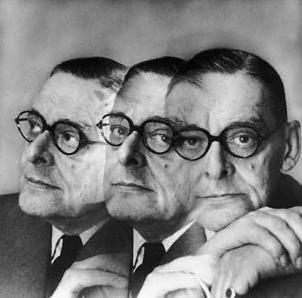
T. S. Eliot


From the Norton Anthology of English Literature (7th ed.):


Thomas Stearns Eliot was born in St. Louis, Missouri, of New England stock. He entered Harvard in 1906 and was influenced there by the anti-Romanticism of Irving Babbitt and the philosophical and critical interests of George Santayana, as well as by the enthusiasm that prevailed in certain Harvard circles for Elizabethan and Jacobean literature, the Italian Renaissance, and Indian mystical philosophy. His philosophical studies included intensive work on the English idealist philosopher F. H. Bradley, on whom he eventually wrote his Harvard dissertation. (Bradley's emphasis on the private nature of individual experience, "a circle enclosed on the outside," had considerable influence on the private imagery of Eliot's poetry and on the view of the relation between the individual and other individuals reflected in much of his poetry). Later, Eliot studied literature and philosophy in France and Germany, before going to England shortly after the outbreak of World War I in 1914. He studied Greek philosophy at Oxford, taught school in London, and then obtained a position with Lloyd's Bank. In 1915 he married an English writer, Vivienne Haigh-Wood, but the marriage was not a success. She was highly neurotic and in increasing bad health. The strain told on Eliot, too. By November 1921 distress and worry had brought him to the verge of a nervous breakdown, and on medical advice, he went to recuperate in a Swiss sanatorium. Two months later he returned, pausing in Paris long enough to give Ezra Pound the manuscript of The Waste Land. Eliot left his wife in 1933; and she was eventually committed to a mental home, where she died in 1947. Ten years later he married again and, for the eight years that remained to him, at last knew happiness.

Eliot started writing literary and philosophical reviews soon after settling in London. He wrote for the Atheaneum and the Times Literary Supplement, among other periodicals, and was assistant editor of the Egoist from 1917 to 1919. In 1922 he founded the influential quarterly Criterion, which he edited until it cesased publication in 1939. His poetry first appeared in 1915, when The Love Song of J. Alfred Profrock was printed in Poetry magazine (Chicago) and a few other short poems were published in the short-lived periodical Blast. His first published collection of poems was Prufrock and Other Observations, 1917; two other small collections followed in 1919 and 1920; in 1922 The Waste Land appeared, first in the Criterion in October, then in the Dial (in America) in November, and finally in book form. Poems 1909-25 (1925) collected these earlier poems. Meanwhile he was also publishing collections of his critical essays, notably The Sacred Wood in 1920 and Homage to John Dryden in 1924. For Lancelot Andrewes followed in 1928 and in 1932 lie included most of these earlier essays with some new ones in Selected Essays. In 1925 he joined the London publishing firm of Faber and Gwyer, becoming a director when the firm became Faber and Faber. He became a British subject and joined the Church of England in 1927.

"Our civilization comprehends great variety and complexity, and this variety and complexity, playing upon a refined sensibility, mut produce various and complex results. The poet must become more and more comprehensive, more allusive, more indirect, in order to force, to dislocate if necessary, language into his meaning." This remark, from Eliot's essay The Metaphysical Poets (1921), gives one clue to his poetic method from Prufrock through The Waste Land. In the tradition of the of the Georgian poets who were active when he settled in London, he saw an exhausted poetic mode being employed, with no verbal excitement or original craftsmanship. He sought to make poetry more subtle, more suggestive, and at the same time more precise. He had learned from the imagists the necessity of clear and precise images, and he learned, too, from the philosopher-poet T. E. Hulme and from his early supporter and adviser Ezra Pound to fear romantic softness and to regard the poetic medium rather than the poet's personality as the important factor. At the same time, the "hard, dry" images advocated by Hulme were not enough for him; he wanted wit, allusiveness, irony. He saw in the Metaphysical poets how wit and passion could be combined, and he saw in the French symbolists how an image could be both absolutely precise in what it referred to physically and at the same time endlessly suggestive in the meanings it set up because of its relationship to other images. The combination of precision, symbolic suggestion, and ironic mockery in the poetry of the late-nineteenth-century poet Jules Laforgue attracted and influenced him, and he was influenced too by other nineetenth-century French poets: by Théophile Gautier's artful carving of impersonal shapes of meaning, by Charles Baudelaire's strangely evocative explorations of the symbolic suggestions of objects and images; by the symbolist poets Paul Verlaine, Arthur Rimbaud, and Stéphane Mallarmé. He also found in the Jacobean dramatists a flexible blank verse with overtones of colloquial movement: Middleton, Tourneur, Webster, and others, taught him as much—in the way of verse movement, imagery, the counterpointing of the accent of conversation and the note of terror—as either the Metaphysicals or the French symbolists.

Hulme's protests against the Romantic concept of poetry fitted in well enough with what Eliot had learned from Irving Babbitt at Harvard, yet for all his severity with such poets as Shelley, for all his conscious cultivation of a classical viewpoint and his insistence on order and discipline rather than on mere self-expression in art, one side of Eliot's poetic genius is, in one sense of the word, Romantic. The symbolist influence on his imagery, his interest in the evocative and the suggestive, such lines as "And fiddled whisper music on those strings / And bats with baby faces in the violet light / Whistled, and beat their wings," and such recurring images as the hyacinth girl and the rose garden, all show what could be called a Romantic element in his poetry. But it is combined with a dry ironic allusivness, a play of wit, and a colloquial element, which are not normally found in poets of the Romantic tradition.

Eliot's real novelty—and the cause of such bewilderment when his poems first appeared—was his deliberate elimination of all merely connective and transitional passages, his building up of the total pattern of meaning through the immediate juxtaposition of images without overt explanation of what they are doing, together with his use of oblique references to other works of literature (some of them quite obscure to most readers of his time). Prufrock presents a symbolic landscape where the meaning emerges from the mutual interaction of the images, and that meaning is enlarged by echoes, often ironic, of Hesiod and Dante and Shakespeare. The Waste Land is a series of scenes and images with no author's voice intervening to tell us where we are, but with the implications developed through multiple contrasts and through analogies with older literary works often referred to in a distorted quotation or a half-concealed allusion. Furthermore, the works referred to are not necessarily works that are central in the Western literary tradition: besides Dante and Shakespeare there are pre-Socratic philosophers, minor (as well as major) seventeenth-century poets and dramatists; works of anthropology, history, and philosophy; and other echoes of the poet's private reading. In a culture where there is no longer any assurance on the part of the poet that his or her public has a common cultural heritage, a common knowledge of works of the past, Eliot felt it necessary to build up his own body of references. It is this that marks the difference between Eliot's use of earlier literature and, say, Milton's. Both poets are difficult to the modern reader, who needs editorial assistance in recognizing and understanding many of the allusions—but Milton was drawing on a body of knowledge common to educated people in his day. Nevertheless, this aspect of Eliot can be exaggerated: the fact remains that the nature of his imagery together with the movement of his verse generally succeed in setting the tone he requires, in establishing the area of meaning to be developed, so that even a reader ignorant of most of the literary allusions can often get the feel of the poem and achieve some understanding of what it says.

Eliot's early poetry, until at least the middle 1920s, is mostly concerned in one way or another with the Waste Land, with aspects of the decay of culture in the modern Western world. After his formal acceptance of Anglican Christianity we find a penitential note in much of his verse, a note of quiet searching for spiritual peace, with considerable allusion to biblical, liturgical, and mystical religious literature and to Dante. Ash Wednesday (1930), a poem in six parts, much less fiercely concentrated in style than the earlier poetry, explores with gentle insistence a mood both penitential and questioning. The so-called Ariel poems (the title has nothing to do with their form or content) present or explore aspects of religious doubt or discovery or revelation, sometimes, as in Marina, using a purely secular imagery and sometimes, as in Journey of the Magi, drawing on biblical incident. In Four Quartets (of which the first, Burnt Norton, appeared in the Collected Poems of 1935, though all four were not completed until 1943, when they were published together) Eliot further explored essentially religious moods, dealing with the relation between time and eternity and the cultivation of that selfless passivity that can yield the moment of timeless revelation in the midst of time. The mocking irony, the savage humor, the deliberately startling juxtapostion of the sordid and the romantic give way in these later poems to a quieter poetic idiom, often still completely allusive but never deliberately shocking.

Eliot's criticism was the criticism of a practicing poet who worked out in relation to his reading of older literature what he needed to hold and to admire. He lent the growing weight of his authority to that shift in literary taste that replaced Milton by Donne as the great seventeenth-century English poet and replaced tennyson in the nineteenthy century by Hopkins. His often-quoted description of the late seventeenth-century "dissociation of sensibility"—keeping wit and passion in separate compartments—which he saw as determining the course of English poetry throughout the eighteenth and nineteenth centuries, is both a contribution to the rewriting of English literary history and an explanation of what he was aiming at in his own poetry: the reestablishment of that unified sensibility he found in Donne and other early seventeenth-century poets and dramatists. His view of tradition, his dislike of the poetic exploitation of the author's own personality, his advocacy of what he called "orthodoxy," made him suspicious of what he considered eccentric geniuses such as Blake and D. H. Lawrence. On the other side, his dislike of the grandiloquent and his insistence on complexity and on the mingling of the formal with the conversational made him distrustful of the influence of Milton on English poets. He considered himself "classicist in literature, royalist in politics, and Anglo-Catholic in religion" (For Lancelot Andrewes, 1928), in favor of order against chaos, tradition against eccentricity, authority against rampant individualism; yet his own poetry is in many respects untraditional and certainly highly individual in tone. His conservative and even authoritarian habit of mind alienated some who admire—and some whose own poetry has been much influenced by—his poetry.

Eliot's plays have all been, directly or indirectly, on religious themes. Murder in the Cathedral (1935) deals with the murder of Archbishop Thomas à Becket in an appropriately ritual manner, with much use of a chorus and with the central speech in the form of a sermon by the archbishop in his cathedral shortly before his murder. The Family Reunion (1939) deals with the problem of guilt and redemption in a modern upper-class English family; it makes a deliberate attempt to combine choric devices from Greek tragedy with a poetic idiom subdued to the accents of drawing-room conversation. In his three later plays, all written in the 1950s, The Cocktail Party, The Confidential Clerk, and The Elder Statesman, he achieved popular success by casting a serious religious theme in the form of a sophisticated modern social comedy, using a verse that is so conversational in movement that when spoken in the theater it does not sound like verse at all.

Critics differ on the degree to which Eliot succeeded in his last plays in combining box-office success with dramatic effectiveness. But there is no disagreement on his importance as one of the great renovators of the English poetic dialect, whose influence on a whole generation of poets, critics, and intellectuals generally was enormous. His range as a poet is limited, and his interest in the great middle ground of human experience (as distinct from the extremes of saint and sinner) deficient, but when in 1948 he was awarded the rare honor of the Order of Merit by King George VI and also gained the Nobel Prize for Literature, his positive qualities weere widely and fully recognized—his poetic cunning, his fine craftsmanship, his original accent, his historical and representative importance, as the poet of the modern symbolist-Metaphysical tradition.


The Waste Land

This is a poem about spiritual dryness, about the kind of existence in which no regenerating belief gives significance and value to people's daily activities, sex brings no fruitfulness, and death heralds no resurrection. Eliot himself gives one of the main clues to the theme and structure of the poem in a general note, in which he stated that "not only the title, but the plan and a good deal of the symbolism of the poem were suggested by Miss Jessie L. Weston's book on the Grail Legend: From Ritual to Romance" (1920). He further acknowledged a general indebtedness to Sir James Frazer's Golden Bough (13 volumes, 1890-1915), "especially the . . . volumes Adonis, Attis, Osiris," in which Frazer deals with ancient vegetation myths and fertility ceremonies. Weston's study, drawing on material from Frazer and other anthropologists, traced the relationship of these myths and rituals to Christianity and most especially to the legend of the Holy Grail. She found an archetypal fertility myth in the story of the Fisher King whose death, infirmity, or impotence (there are many forms of the myth) brought drought and desolation to the land and failure of the power to reproduce themselves among both humans and beasts. This symbolic Waste Land can be revived only if a "questing knight" goes to the Chapel Perilous, situated in the heart of it, and there asks certain ritual questions about the Grail (or Cup) and the Lance—originally fertility symbols, female and male, respectively. The proper asking of these questions revives the king and restores fertility to the land. The relation of this original Grail myth to fertility cults and rituals found in many different civilizations, and represented by stories of a dying god who is later resurrected (e.g., Tammuz, Adonis, Attis) shows their common origin in a response to the cyclical movement of the seasons, with vegetation dying in winter to be resurrected again in the spring. Christianity, according to Weston, gave its own spiritual meaning to the myth; it "did not hesitate to utilize the already existing medium of instruction, but boldly identified the Deity of Vegetation, regarded as Life Principle, with the God of the Christian Faith." The Fisher King is related to the use of the fish symbol in early Christianity. Weston states "with certainty that the Fish is a Life symbol of immemorial antiquity, and that the title of Fisher has, from the earliest ages, been associated with the Deities whio were held to be specially connected with the origin and preservation of Life." Eliot, following Weston, thus uses a great variety of mythological and religious material, both Occidental and Oriental, to paint a symbolic picture of the modern Waste Land and the need for regeneration. The terror of that life—its loneliness, emptiness, and irrational apprehensions—as well as its misuses of sexuality are vividly presented, but paradoxically, the poem ends with a benediction. Another significant general source for the poem is the composer Richard Wagner, some of whose operas (Götterdämmerung ["Twilight of the Gods"], Parsifal, Rheingold, and Tristand and Isolde) are drawn on.

The poem as published owed a great deal to the severe pruning of Ezra Pound; the original manuscript, with Pound's excisions and comments, provides fascinating information about the genesis and development of the poem. It was reproduced in facsimile in 1971, edited by Eliot's widow, Valerie Eliot, who also supplied notes supplementing those that Eliot himself added when the poem was first published in book form in 1922 and that are included with the present editors' footnotes to the poem.


—oOo—

Un blog sobre literatura inglesa (y norteamericana)

  Este blog fue utilizado como material auxiliar para una asignatura del grado de Lenguas Modernas en la Universidad de Zaragoza, asignatur...