From the Norton Anthology of English
Literature (7th ed.):
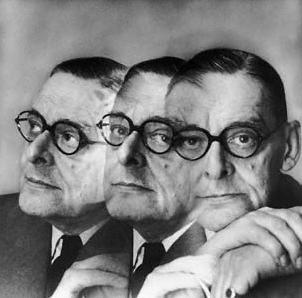
Thomas Stearns Eliot was born in St. Louis, Missouri, of New England stock. He entered Harvard in 1906 and was influenced there by the anti-Romanticism of Irving Babbitt and the philosophical and critical interests of George Santayana, as well as by the enthusiasm that prevailed in certain Harvard circles for Elizabethan and Jacobean literature, the Italian Renaissance, and Indian mystical philosophy. His philosophical studies included intensive work on the English idealist philosopher F. H. Bradley, on whom he eventually wrote his Harvard dissertation. (Bradley's emphasis on the private nature of individual experience, "a circle enclosed on the outside," had considerable influence on the private imagery of Eliot's poetry and on the view of the relation between the individual and other individuals reflected in much of his poetry). Later, Eliot studied literature and philosophy in France and Germany, before going to England shortly after the outbreak of World War I in 1914. He studied Greek philosophy at Oxford, taught school in London, and then obtained a position with Lloyd's Bank. In 1915 he married an English writer, Vivienne Haigh-Wood, but the marriage was not a success. She was highly neurotic and in increasing bad health. The strain told on Eliot, too. By November 1921 distress and worry had brought him to the verge of a nervous breakdown, and on medical advice, he went to recuperate in a Swiss sanatorium. Two months later he returned, pausing in Paris long enough to give Ezra Pound the manuscript of The Waste Land. Eliot left his wife in 1933; and she was eventually committed to a mental home, where she died in 1947. Ten years later he married again and, for the eight years that remained to him, at last knew happiness.
Eliot started writing literary and philosophical reviews soon after settling in London. He wrote for the Atheaneum and the Times Literary Supplement, among other periodicals, and was assistant editor of the Egoist from 1917 to 1919. In 1922 he founded the influential quarterly Criterion, which he edited until it cesased publication in 1939. His poetry first appeared in 1915, when The Love Song of J. Alfred Profrock was printed in Poetry magazine (Chicago) and a few other short poems were published in the short-lived periodical Blast. His first published collection of poems was Prufrock and Other Observations, 1917; two other small collections followed in 1919 and 1920; in 1922 The Waste Land appeared, first in the Criterion in October, then in the Dial (in America) in November, and finally in book form. Poems 1909-25 (1925) collected these earlier poems. Meanwhile he was also publishing collections of his critical essays, notably The Sacred Wood in 1920 and Homage to John Dryden in 1924. For Lancelot Andrewes followed in 1928 and in 1932 lie included most of these earlier essays with some new ones in Selected Essays. In 1925 he joined the London publishing firm of Faber and Gwyer, becoming a director when the firm became Faber and Faber. He became a British subject and joined the Church of England in 1927.
"Our civilization comprehends great variety and complexity, and this variety and complexity, playing upon a refined sensibility, mut produce various and complex results. The poet must become more and more comprehensive, more allusive, more indirect, in order to force, to dislocate if necessary, language into his meaning." This remark, from Eliot's essay The Metaphysical Poets (1921), gives one clue to his poetic method from Prufrock through The Waste Land. In the tradition of the of the Georgian poets who were active when he settled in London, he saw an exhausted poetic mode being employed, with no verbal excitement or original craftsmanship. He sought to make poetry more subtle, more suggestive, and at the same time more precise. He had learned from the imagists the necessity of clear and precise images, and he learned, too, from the philosopher-poet T. E. Hulme and from his early supporter and adviser Ezra Pound to fear romantic softness and to regard the poetic medium rather than the poet's personality as the important factor. At the same time, the "hard, dry" images advocated by Hulme were not enough for him; he wanted wit, allusiveness, irony. He saw in the Metaphysical poets how wit and passion could be combined, and he saw in the French symbolists how an image could be both absolutely precise in what it referred to physically and at the same time endlessly suggestive in the meanings it set up because of its relationship to other images. The combination of precision, symbolic suggestion, and ironic mockery in the poetry of the late-nineteenth-century poet Jules Laforgue attracted and influenced him, and he was influenced too by other nineetenth-century French poets: by Théophile Gautier's artful carving of impersonal shapes of meaning, by Charles Baudelaire's strangely evocative explorations of the symbolic suggestions of objects and images; by the symbolist poets Paul Verlaine, Arthur Rimbaud, and Stéphane Mallarmé. He also found in the Jacobean dramatists a flexible blank verse with overtones of colloquial movement: Middleton, Tourneur, Webster, and others, taught him as much—in the way of verse movement, imagery, the counterpointing of the accent of conversation and the note of terror—as either the Metaphysicals or the French symbolists.
Hulme's protests against the Romantic concept of poetry fitted in well enough with what Eliot had learned from Irving Babbitt at Harvard, yet for all his severity with such poets as Shelley, for all his conscious cultivation of a classical viewpoint and his insistence on order and discipline rather than on mere self-expression in art, one side of Eliot's poetic genius is, in one sense of the word, Romantic. The symbolist influence on his imagery, his interest in the evocative and the suggestive, such lines as "And fiddled whisper music on those strings / And bats with baby faces in the violet light / Whistled, and beat their wings," and such recurring images as the hyacinth girl and the rose garden, all show what could be called a Romantic element in his poetry. But it is combined with a dry ironic allusivness, a play of wit, and a colloquial element, which are not normally found in poets of the Romantic tradition.
Eliot's real novelty—and the cause of such bewilderment when his poems first appeared—was his deliberate elimination of all merely connective and transitional passages, his building up of the total pattern of meaning through the immediate juxtaposition of images without overt explanation of what they are doing, together with his use of oblique references to other works of literature (some of them quite obscure to most readers of his time). Prufrock presents a symbolic landscape where the meaning emerges from the mutual interaction of the images, and that meaning is enlarged by echoes, often ironic, of Hesiod and Dante and Shakespeare. The Waste Land is a series of scenes and images with no author's voice intervening to tell us where we are, but with the implications developed through multiple contrasts and through analogies with older literary works often referred to in a distorted quotation or a half-concealed allusion. Furthermore, the works referred to are not necessarily works that are central in the Western literary tradition: besides Dante and Shakespeare there are pre-Socratic philosophers, minor (as well as major) seventeenth-century poets and dramatists; works of anthropology, history, and philosophy; and other echoes of the poet's private reading. In a culture where there is no longer any assurance on the part of the poet that his or her public has a common cultural heritage, a common knowledge of works of the past, Eliot felt it necessary to build up his own body of references. It is this that marks the difference between Eliot's use of earlier literature and, say, Milton's. Both poets are difficult to the modern reader, who needs editorial assistance in recognizing and understanding many of the allusions—but Milton was drawing on a body of knowledge common to educated people in his day. Nevertheless, this aspect of Eliot can be exaggerated: the fact remains that the nature of his imagery together with the movement of his verse generally succeed in setting the tone he requires, in establishing the area of meaning to be developed, so that even a reader ignorant of most of the literary allusions can often get the feel of the poem and achieve some understanding of what it says.
Eliot's early poetry, until at least the middle 1920s, is mostly concerned in one way or another with the Waste Land, with aspects of the decay of culture in the modern Western world. After his formal acceptance of Anglican Christianity we find a penitential note in much of his verse, a note of quiet searching for spiritual peace, with considerable allusion to biblical, liturgical, and mystical religious literature and to Dante. Ash Wednesday (1930), a poem in six parts, much less fiercely concentrated in style than the earlier poetry, explores with gentle insistence a mood both penitential and questioning. The so-called Ariel poems (the title has nothing to do with their form or content) present or explore aspects of religious doubt or discovery or revelation, sometimes, as in Marina, using a purely secular imagery and sometimes, as in Journey of the Magi, drawing on biblical incident. In Four Quartets (of which the first, Burnt Norton, appeared in the Collected Poems of 1935, though all four were not completed until 1943, when they were published together) Eliot further explored essentially religious moods, dealing with the relation between time and eternity and the cultivation of that selfless passivity that can yield the moment of timeless revelation in the midst of time. The mocking irony, the savage humor, the deliberately startling juxtapostion of the sordid and the romantic give way in these later poems to a quieter poetic idiom, often still completely allusive but never deliberately shocking.
Eliot's criticism was the criticism of a practicing poet who worked out in relation to his reading of older literature what he needed to hold and to admire. He lent the growing weight of his authority to that shift in literary taste that replaced Milton by Donne as the great seventeenth-century English poet and replaced tennyson in the nineteenthy century by Hopkins. His often-quoted description of the late seventeenth-century "dissociation of sensibility"—keeping wit and passion in separate compartments—which he saw as determining the course of English poetry throughout the eighteenth and nineteenth centuries, is both a contribution to the rewriting of English literary history and an explanation of what he was aiming at in his own poetry: the reestablishment of that unified sensibility he found in Donne and other early seventeenth-century poets and dramatists. His view of tradition, his dislike of the poetic exploitation of the author's own personality, his advocacy of what he called "orthodoxy," made him suspicious of what he considered eccentric geniuses such as Blake and D. H. Lawrence. On the other side, his dislike of the grandiloquent and his insistence on complexity and on the mingling of the formal with the conversational made him distrustful of the influence of Milton on English poets. He considered himself "classicist in literature, royalist in politics, and Anglo-Catholic in religion" (For Lancelot Andrewes, 1928), in favor of order against chaos, tradition against eccentricity, authority against rampant individualism; yet his own poetry is in many respects untraditional and certainly highly individual in tone. His conservative and even authoritarian habit of mind alienated some who admire—and some whose own poetry has been much influenced by—his poetry.
Eliot's plays have all been, directly or indirectly, on religious themes. Murder in the Cathedral (1935) deals with the murder of Archbishop Thomas à Becket in an appropriately ritual manner, with much use of a chorus and with the central speech in the form of a sermon by the archbishop in his cathedral shortly before his murder. The Family Reunion (1939) deals with the problem of guilt and redemption in a modern upper-class English family; it makes a deliberate attempt to combine choric devices from Greek tragedy with a poetic idiom subdued to the accents of drawing-room conversation. In his three later plays, all written in the 1950s, The Cocktail Party, The Confidential Clerk, and The Elder Statesman, he achieved popular success by casting a serious religious theme in the form of a sophisticated modern social comedy, using a verse that is so conversational in movement that when spoken in the theater it does not sound like verse at all.
Critics differ on the degree to which Eliot succeeded in his last plays in combining box-office success with dramatic effectiveness. But there is no disagreement on his importance as one of the great renovators of the English poetic dialect, whose influence on a whole generation of poets, critics, and intellectuals generally was enormous. His range as a poet is limited, and his interest in the great middle ground of human experience (as distinct from the extremes of saint and sinner) deficient, but when in 1948 he was awarded the rare honor of the Order of Merit by King George VI and also gained the Nobel Prize for Literature, his positive qualities weere widely and fully recognized—his poetic cunning, his fine craftsmanship, his original accent, his historical and representative importance, as the poet of the modern symbolist-Metaphysical tradition.
The Waste Land
This is a poem about spiritual dryness, about the kind of existence in which no regenerating belief gives significance and value to people's daily activities, sex brings no fruitfulness, and death heralds no resurrection. Eliot himself gives one of the main clues to the theme and structure of the poem in a general note, in which he stated that "not only the title, but the plan and a good deal of the symbolism of the poem were suggested by Miss Jessie L. Weston's book on the Grail Legend: From Ritual to Romance" (1920). He further acknowledged a general indebtedness to Sir James Frazer's Golden Bough (13 volumes, 1890-1915), "especially the . . . volumes Adonis, Attis, Osiris," in which Frazer deals with ancient vegetation myths and fertility ceremonies. Weston's study, drawing on material from Frazer and other anthropologists, traced the relationship of these myths and rituals to Christianity and most especially to the legend of the Holy Grail. She found an archetypal fertility myth in the story of the Fisher King whose death, infirmity, or impotence (there are many forms of the myth) brought drought and desolation to the land and failure of the power to reproduce themselves among both humans and beasts. This symbolic Waste Land can be revived only if a "questing knight" goes to the Chapel Perilous, situated in the heart of it, and there asks certain ritual questions about the Grail (or Cup) and the Lance—originally fertility symbols, female and male, respectively. The proper asking of these questions revives the king and restores fertility to the land. The relation of this original Grail myth to fertility cults and rituals found in many different civilizations, and represented by stories of a dying god who is later resurrected (e.g., Tammuz, Adonis, Attis) shows their common origin in a response to the cyclical movement of the seasons, with vegetation dying in winter to be resurrected again in the spring. Christianity, according to Weston, gave its own spiritual meaning to the myth; it "did not hesitate to utilize the already existing medium of instruction, but boldly identified the Deity of Vegetation, regarded as Life Principle, with the God of the Christian Faith." The Fisher King is related to the use of the fish symbol in early Christianity. Weston states "with certainty that the Fish is a Life symbol of immemorial antiquity, and that the title of Fisher has, from the earliest ages, been associated with the Deities whio were held to be specially connected with the origin and preservation of Life." Eliot, following Weston, thus uses a great variety of mythological and religious material, both Occidental and Oriental, to paint a symbolic picture of the modern Waste Land and the need for regeneration. The terror of that life—its loneliness, emptiness, and irrational apprehensions—as well as its misuses of sexuality are vividly presented, but paradoxically, the poem ends with a benediction. Another significant general source for the poem is the composer Richard Wagner, some of whose operas (Götterdämmerung ["Twilight of the Gods"], Parsifal, Rheingold, and Tristand and Isolde) are drawn on.
The poem as published owed a great deal to the severe pruning of Ezra Pound; the original manuscript, with Pound's excisions and comments, provides fascinating information about the genesis and development of the poem. It was reproduced in facsimile in 1971, edited by Eliot's widow, Valerie Eliot, who also supplied notes supplementing those that Eliot himself added when the poem was first published in book form in 1922 and that are included with the present editors' footnotes to the poem.
—oOo—

